




Allied Doctrine had seen little development between the war with significant budget cuts. The Army was relegated to an Imperial policing role. It is very Command and Control way of managing the battle and managing the troops.
We look at Sir John Dill and his visit to Tannenburg and his interpretation of ‘Mission Command’.
Malaya was a very laissez-faire appraoch from the British point of view, with some units preferring not to train in the jungle.
LT COL Ian Stewart from the Argyll and Sutherland Highlanders. He trained one of the best battalions in Malaya. How was his training methodologies viewed at Malaya Command?
British Staff College focused on strategy, not on Brigade and Division Command, which meant that British officers struggled when commanding one up.
How did the 8th Division transition from the training for desert fighting once they landed in Malaya?
What was the thinking about Combined Arms and how was it trained for?
How did MAG GEN Gordon Bennett train the Division for the withdrawal and what where his thoughts on digging in?
How did the personalities of the individual Battalion Commanders impact each of their battalions.
The Japanese developed a Jungle Warfare in Taiwan to develop doctrine. They also conducted 10 major exercises for amphibious operations.
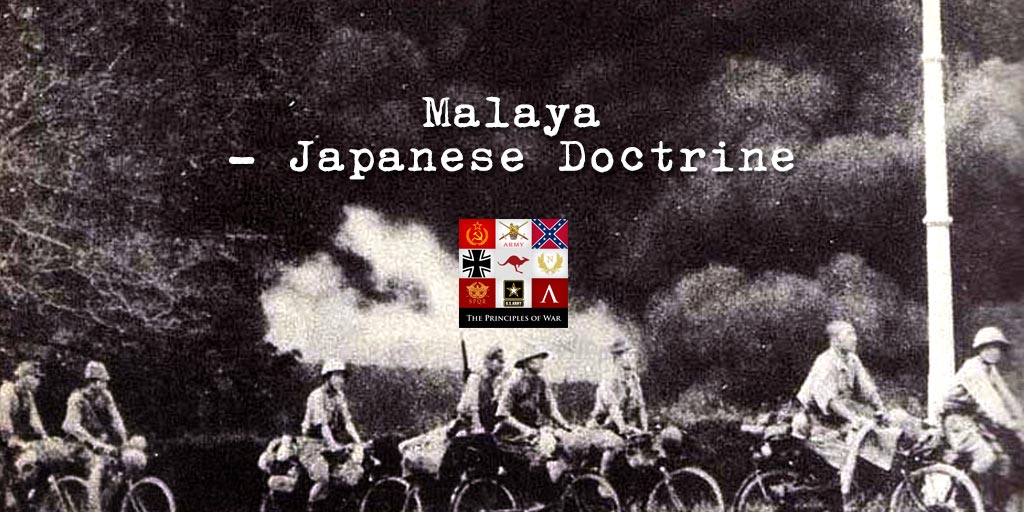
The reliance on the bicycle enabled rapid movements of troops with very little logistics impact.
The difference between the Japanese and British highlighted the amount of recent modern warfare experience that each Army had been subjected to.
How did the road impact the thinking for each of the commanders? How would it shape their actions and dispositions.
What is fighting for the road off the road and how did the British and Indian troops respond to this tactic?
How did the Japanese task organise for their upcoming offensive?
8th Division started from the ground up to develop their doctrine, which meant that there was still significant work to be done after first contact with the enemy.


Transcript
Comparing Japanese and British Doctrine in Malaya
This is the Principles of War podcast, professional military education for junior officers and senior NCOs.
Welcome back, everyone. So terrain lasted a little bit longer than I thought, so we didn’t really get to look at doctrine at all. We did get to have a little bit of a look at the makeup of the British and Japanese forces. We also had a look at the terrain. So predominantly mountain, predominantly jungle, with some open spaces on the coasts, roads running down the east and west coasts with very few laterals. So now we’re going to look at doctrine. This is really interesting because this is where we get to see the terrain matching up with the way that the both of the units are planning on fighting their campaign.
So starting off with the Allied doctrine, and so we know that the British doctrine had not progressed well during the interwar years, so they were quite slow to start rearming and thinking about another major war after the Great War. The budget was very tight after the First World War and the army had been relegated predominantly to an imperial policing role. And so the budget cuts and the change in focus from fighting a mainland battle to imperial policing had really created a lot of stagnation from a doctrinal thinking point of view. So people like Liddell Hart, who was a visionary of the way that World War II was going to be fought, his thinking and his input into doctrine was pretty much picked up by the Germans and used against the British, rather than the British using that.
And a lot of it was because of the fact that they couldn’t afford the equipment that they needed to be able to enact that kind of thinking, along with a whole range of other issues like inflexible thinking and the fact that they had won, so the Germans hadn’t won. So they knew that their doctrine wasn’t good enough. They knew that they needed to be thinking of new ways of fighting. And this is where we come back to this whole thinking about victory is a very poor teacher, especially when it comes to military doctrine. So we find the British thinking in a very still a very command and control orientated way. I saw a really interesting passage in a book called Raising Churchill’s Army. David French argued that the British failed to recognise the advantage of giving subordinates wider latitude to use their own initiative.
Indeed, they believed that such latitude was a positive handicap to success. So visiting the battlefield at Tannenberg in 1935, Sir John Dill, now Sir John Dill, he became the chief of the Imperial general staff in 1940. So a not unimportant person in the British Army. He’s visiting the Battle of Tannenberg in 1935. So this is one of Germany’s greatest victories in World War I. And he asked his host how the Germans had achieved such success despite the notorious disobedience of their junior officers. And that really struck me as a fundamental problem for the way that the British army was entirely thinking about combat coming into the 1940s because they just don’t want junior officers to be thinking by themselves, they still want them to be following orders.
Now in Malaya there were no schools, there was no doctrine that was common amongst the units that were there and there was no lessons learned type approach. They had a very laissez faire approach to training. So some directives would come out and Percival issued some directives, but there was no follow up to see how that was being followed through to an individual unit at the unit level. Now, some of the units didn’t train in the jungle, which is probably a significant problem when most of the. When over half of the land mass is jungle. Now many had a siesta between 1400 and 1600 to prevent heat stroke.
Now it’s kind of to prevent heat stroke, but it’s also, I think it’s a little bit hot out there and it’s a lot nicer in the mess, isn’t it, where it’s a bit cooler and we can all have a little bit of a nice cool drink. Now one of the other problems that the British had would they tend to send individual battalions on rotations, so they would often go without their supporting arms. And this meant that there was very little opportunity to practise combined arms. And this again is a significant problem. If you’re doing imperial policing, then much less of a problem because you’re not expecting to use artillery, engineers, armour, those kind of. There’s very little need to generate that combined arms effect because that’s only required when you’re fighting a real war, which they weren’t planning on doing.
Now, as the strategic situation worsened, in September 1939, the 12th Indian Brigade was sent to Malaya as part of the garrison there. And as a part of that There was the 2nd Battalion, Argyll and Sutherland Highlanders under the command of Lt. Col. Ian Stewart. Now he was a little bit different to your typical co, so he trained his troops intensive jungle warfare. They spent so much time out in the jungle that they became known as the jungle beasts. He used tiger patrols, which were four man hit and run teams that were. And they trained in encircling and filleting attacks. And these filleting attacks is where they would charge down the road and punch through a defensive position and then move on to the rear echelon. They had a fearsome reputation and they had a fearsome reputation before the Japanese landed.
Now, part of that reputation had been earned in the Battle of Lavender street, where unfortunately, an Australian soldier was killed. So their reputation was as one of the best battalions in Malaya, Commander. And they were able to withstand tank attacks, they were able to retreat in good order and they were continually ambushing the Japanese. They took fearful casualties, partially because they were one of the go to battalions that Heath was using because of the fact that a lot of the other battalions were just falling apart. Now you’ve got Lt. Col. Stewart coming up with modern doctrine. He’s pushing his troops out into the jungle. They’re working with the jungle, they’re. They’re becoming very comfortable with it, very aggressive training. And you start to think, I wonder what his par would be looking like.
He’s obviously doing a great job creating one of the best battalions in Malaya command. Wrong. He was actually labelled by Brigadier Torrance as a crank. Now he was Percival’s Chief of Staff and initially I thought that he was labelled as a crank because he was making everyone else look bad. So at 1400, where everyone’s sort of knocking off because it’s a little bit hot outside and we might go and have a couple of Singapore sings down at Raffles and you just kind of look bad, knowing that Lt. Col. Stewart is out there pushing his men in the jungle. I thought that was why he was getting the bad reputation. It wasn’t because of that. It was because he was teaching battle drills to his soldiers.
So contact drills, very basic things that he was teaching them the ability to react very quickly to changing circumstances on the battlefield. He was teaching his troops to be able to react to the changing situation on the battlefield without the input of the junior leaders. So the lieutenants and the sergeants. Now, there was a couple of reasons that Stuart was doing this. One, command and control in the jungle is very difficult, so you want people to be seizing the initiative when they need to. And the other thing is, if you lose a lieutenant or a sergeant, the troops are still able to carry on and still able to carry out the intent of what it is they’re meant to be doing. This is at the exact opposite of what the British methodology, command and control thinking was all about.
You don’t really want the troops to be thinking too much because if they start thinking, then they might start questioning orders. And all of the training was around blind obedience to orders, which is all well and good, as long as there is someone there to be able to give orders and you’re in a position to be able to receive the orders. So in combat, it’s not the easiest place to communicate. And drills are a way of short circuiting this. It’s a way of tightening your OODA loop. It’s a way of acting and reacting to the enemy’s moves a lot quicker. This is what made the second Argyle and Sutherland Highlanders one of the best battalions in Malaya Command. And that was only proven by their experience in combat. Up until that, he was labelled as a crank.
And I think that this is really one of those interesting things where you look at the role of a leader, the leader needs to come up with that vision thing. Where is the organisation today? Where does it need to be tomorrow? And there was a couple of things that Stuart did in his appreciation. He realised that they were going to need to be able to fight in the jungle. Were they good at fighting in the jungle? No. Well, how about we get out and train in the jungle? How about we train really hard so that we’re a strong, effective combat unit? He was able to do that gap analysis between where the battalion was and where he wanted it to be, and he created a programme to get them to that point. In the end, that paid off.
The problem was that other people in Malaya Command, most of the other people in Malaya Command, didn’t share his vision. And this is one of the big problems, this inflexible thinking that permeated all, almost all of Malaya Command. No one was actually thinking about what it was going to be like to fight in, to actually fight the Japanese in Malaya, which is really quite an amazing statement, but it’s borne out by all of the actions and the way that they prepared for this battle. Now, there was a couple of other interesting issues with the British doctrine. The British Staff College taught officers to be strategists. It didn’t teach them to be brigade or division commanders. And so they often struggled acting one up. And so when you’re looking at military on the job performance, there’s an old saying, back em or sack em.
And as the route started, and it started right at the start at Jitra, within days of the Japanese landing, they started to look at brigade and div commanders and it was very hard to find replacements because people weren’t able to think in that one up position. That’s a Big problem. There’s a great picture of Lieutenant Colonel Stewart, which I’ll include in the show notes. He’s advancing through mangrove swamp. It’s obviously a training exercise because they don’t have weapons. He’s there with Major McDonald and Sergeant Major Munich and they’ve got mud up to their knees. They got their bonnets on. He’s out there training with his men. The terrain is just obviously awful. The number of times though that you hear about units who needed to traipse through swamp after the Japanese landed and the number of times that people struggled with it.
He was setting his troops up for success. And I think that was, if only more people had been thinking like that, then the outcome could have been significantly different when the Australians got there. So when 22nd Brigade arrived within Malaya, Brigadier Taylor toured the commands looking for guidance. He wanted to find what is it that we need to do here? What doctrine have we got? How are we going to fight in the jungle? So because one of the issues that the Australian troops had was that all their training was based around fighting in the desert. So 6th Division went to the desert, 7th Division went to the desert. 8th Division was meant to go to the desert and listening to some of the stories of the junior officers and senior NCOs. They were on the Queen Mary, which was acting as a troop ship.
They didn’t know that they weren’t going to the desert. It was a surprise to them to roll up in Singapore. So it was a last minute decision to send the 22nd Brigade, which was the first brigade, to get there. And so Brigadier Taylor just decided that they would return to the basics. And he tried to acclimatise them to operating in the jungle. He found that when they started to move into the jungle, the young officers were initially scared of the jungle. Movement slowed. They were unable to adapt to the way of, to the lack of vision. The command and control were issues. They became easily lost. So there was a lot of difficulties because all of their training had been around fighting in the desert.
And apart from fighting in the Arctic, I can’t think of anything more removed than the desert than moving into jungle. Now as they were preparing, there was still some issues. It was difficult to get time at the range. There was lack of confidence in company weapons and there was no opportunity for battle inoculation. Lack of physical training as well, and little night training. Night was an area where the Japanese excelled and were clearly better than most of the units that they faced. There were few exercises above battalion level and very few were supporting Arms. This was just not something that was planned for and I’m not really sure why it was. Some COs had actually planned to work with the artillery and were told not to by Bennett.
Another thing that was really interesting is one of the most difficult things to do on the battlefield is to conduct the withdraw. So Bennett said there’ll be no practising for the withdrawal because it’s bad for morale. Now the morale is the. You know, this is the leadership’s job to make sure that morale is. Is as high as possible. There’s lots of reasons for conducting the withdrawal. If you’re in a situation where you need to withdraw and you haven’t practised the withdrawal, then the withdrawal is going to be a lot worse than it could have been or should have been. And then your morale is going to be a lot worse, which means you’re probably going to have to withdraw again. That’s something that you haven’t rehearsed for and it’s probably going to go badly, which means that morale is going to deteriorate again.
You get into a really vicious feedback loop. It is mind boggling that Bennett would say no planning for the withdrawal. This concern about doing basic things in the defence is. It seemed to have permeated a lot of eighth division. So Gallagher’s second 30th gamas, there was no digging in. He thought that would be bad for morale. So you’re in an environment where the enemy. And so at Gamas, pretty much air supremacy for the Japanese and they were using it relentlessly and you’ve decided not to dig in. So as the Japanese come in overhead dropping bombs and there’s very little Allied air force in the air, they’re doing this with impunity and you haven’t dug in. I would have thought that would have been bad for morale. And it’s a basic thing to do, particularly for people who had World War I experience.
This is another thing that is really hard to fathom why they would make a decision like that. Now, obviously none of us have experienced the conditions in World War I, but if you read some of the accounts, and I think probably one of the best accounts is by Erwin Rommel in his Infantry Attack. And I remember after one of the battles, his troops got into a defensive position late at night. They’d been fighting all day or they’d been climbing up a mountain. It was some sort of mountain fighting. I can’t remember particularly where it was. And the troops were dog tired and so he let them all go to sleep. Half an hour later, they were shelled and they took 20 casualties. And he said, that was the last time I ever let men not dig in. Now, you learn these lessons.
Rommel learned that lesson. Can’t we just read what Rommel did and go, yep, that’s a good lesson, and carry on with that? And this is the thing that I find absolutely fascinating. Gallagher had World War I experience. There were people throughout the battalion and throughout the division who had World War I experience. You would have thought that these basics would have been picked up on, but no. Now, another concern about the Battle of Gamass is Gallagher ordered his 25 pounders forward with the infantry for direct fire capability. Now, this is an interesting way of employing artillery, and it’s an argument that was pretty much sorted out in the Civil War. You don’t place your artillery forward with the troops because the gunners can be shot and then they’re not able to serve their guns and then your guns are out of action.
They’re much better off in an indirect role. If you want them firing in a direct fire role, they don’t need to be right next to the infantry. So this defensive battle is being fought. It doesn’t go well. The battalion mortars are abandoned, several Vickers guns are abandoned and three 25 pounders are left on the battlefield because of poor emplacement, not understanding how to employ artillery. And these are those lessons that are learned on the battlefield. They’re learnt very expensively. It’s interesting to look at. So Farrell and Pratten talk about the way that the different battalions were developing. And a lot of it came down to the good thing about being a CO is this is your big opportunity to implant your. Your leadership skills, your training programme onto your battalion. And it was interesting looking at the differences between them.
The second 19th was the closest battalion in the division, so it had started off under Maxwell, who was a doctor in civilian life. So he was a doctor. He was only a CO for a short period of 2nd 19th because he then got promoted to Brigade Commander. We’ll talk about that a bit later, because that’s a colourful move. Hand it over to Anderson. And we’re going to talk about Lt. Col. Anderson a lot more in one of the later podcasts. An outstanding co, so very close knit. Both of them really cared for their troops, but Bennett found that they were slow to react because there was a lot of consultation that went on within the leadership group. Second 30th, they were a very tough battalion. They’d had months of. And it’s described as bullying by Galligan. But a very tough battalion.
2nd 20th had the best military skills. Now they’d come up under the CO of Lt. Col. Jeter. Jeter had a nervous breakdown. He had significant problems within the battalion. I think there was elements of him being a martinet, he wasn’t well WR respected by the troops. That was the one thing that was missing because it was quite sad when he was replaced because he had produced the battalion with the best military skills. 226 was quietly improving under boys. There were concerns for two 18th and second 29th under Varley and Robertson. This was what they were like before they’d actually entered combat. And it’s interesting that the final fighting in the Malaya campaign, Aya Hatam Mersing they showed that the Australians were learning, they were reacting very well at Air Bemban, which came after they were starting to find the Japanese to be predictable.
And for any unit, finding that you’re now cut off would be quite a unnerving experience. Particularly when there’s. You’ve got trucks to get out, there’s only one road out and the Japanese have set up a roadblock behind you. The big thing was that was usually infantry that had done that and there wasn’t a lot of them. So it was the way to defeat them doctrinally was to stay in place and wait for someone to come in and wait for another unit to come in and clear the roadblock behind you, or to just smash your own way out. And they did that on multiple occasions. It wasn’t something that required panic. You just needed to be able to think in all round defence and to be able to move in all round defence. And that was a critical skill that needed to be learned.
And we’ll look at some of the things that happen where they needed that, particularly in the second 19th and Lt. Col. Anderson. When it came to close quarters battle, when it came to bayonet fighting, the Australians usually bested the Japanese. So there were a lot of things doctrinally that were working quite well for the Australians. They just needed a little bit more time to get themselves settled and to understand what it was to actually fight in the jungle and to fight the Japanese. The more time that they spent fighting the Japanese, the more they were able to understand how they fought and be able to come up with countermeasures for that. But sadly for Malaya Command, it was too little, too late.
There were too few units that were comfortable fighting in the jungle and there were too few units that were comfortable fighting the Japanese and that led to the withdrawal off the Malaya peninsula to Singapore. So let’s now have a look at Japanese doctrine. Now, the interesting thing is that the Japanese weren’t experts in jungle warfare up until this point. They’d established a jungle warfare centre in Taiwan to research it, the Taiwan Army Research Section. They even dispatched a Captain Kunitake Terito, and he toured Malaya and Singapore in civilian clothes from January to March in 1941, conducting a very extensive research of exactly what it was like to the terrain that they were going to be fight on. They developed a doctrine. They then conducted 10 major exercises in Taiwan and Henan around amphibious exercises, moving forces by sea, opposed landings in difficult weather.
And they also looked at some fairly unconventional things as well. So using bicycles to improve mobility. And this is something that we’re going to talk about more in some of the other podcasts, but it’s really interesting, the use of bicycles and I think at one point they had like 30,000 bicycles, so that they were able to. That the infantry were able to move themselves with some sort of expectation of being able to keep up with the armour. They also worked on their advance to contact and being able to assault from off the line of march. This was something that was really important to them. And they worked on what was called a filleting attack. They also worked on their combined arms in the jungle. Their amphibious warfare doctrine emphasised surprise and concealment over heavy bombardment.
They would usually launch in darkness where possible, dispersed landings to outflank defenders and assaulting forces to press inland as rapidly as possible. And their doctrine really was much further advanced than the British doctrine because the Japanese had already had a couple of years of significant combat in China, and experience had taught them how to minimise their weaknesses and maximise their strengths, mobility and manoeuvre over firepower. And it’s interesting because one of the things that they didn’t cope with well was when the Allies were actually able to coordinate offensive support, it often had devastating effects against the Japanese. It wasn’t something that they were able to deal with well at all. They were very strong on battlefield tactics, combat leadership, particularly at a low level, combined arms at unit level, night operations. And they really stressed the initiative of junior leaders.
When it came to combined arms. Artillery was neglected and armour was penny packeted out in support of infantry operations. With their offensive operations, they always tried to maintain close contact and envelopment tactics. They had an obsession with the bayonet and officers used samurai swords. There’s multiple examples of where officers would charge with samurai swords and there’s one example where an officer charges across a bridge and cuts the deck cord for the demolitions on the bridge with his Samurai sword. A light machine gun was the main weapon of the small units, and medium machine guns were at battalion level and each infantry battalion had a medium machine gun company. The Japanese understood that opportunities on the battlefield are fleeting and capitalisation of those opportunities requires junior leaders to seize the initiative it was expected of them.
The results of the exercise were all put together and the work was endorsed by the General staff. And on the 12th of August, they ordered the 25th army to prepare for the invasion of Malaya. A 70 page manual was published and there was 400,000 copies of it produced. And it was entitled Read this alone and the War Can Be Won. It covered political and terrain information with motivation and morale. They saw that the mix of races defending Malaya was a weakness to exploit and the Indian troops were held in near contempt. One of the things that was interesting is they said the type of terrain is regarded by the weak, spirited Westerners as impenetrable. And for this reason, in order to outmanoeuvre them, we must from time to time force our way through it. With proper preparation and determination, it can be done.
Now, we’ve already discussed how the road was the central tactical feature. So there were two ways that the Japanese were going to respond to this. The first one was the filleting attack. And this was where they would have an armour heavy force punch through defences and just to continue on into the rear areas. And on multiple occasions they would drive, continue to drive and continue to drive further 10, 20 kilometres after the initial contact with the enemy. And there were instances where units would just sit and watch the tanks drive by. So Allied units would just sit and watch the Japanese tanks drive by because there was nothing that they could do to stop them.
And on multiple occasions they ran into units just driving up the road, batteries of guns just destroyed on the road before they could un limber because they had no warning that the tanks were in the area. Now, the other tactic that they would use was it was they talked about fighting for the road off the road and there would be an advance to contact, a holding force would be put in place and then the infantry would move onto the flanks and they would start looking for the gaps and they would work around the defending force and then they would move into the rear and then they would place roadblocks behind the defenders. And particularly for the Indian troops, this was incredibly unnerving.
And units would just pack up and leave in an effort, because they knew that they were now surrounded and panic would set in. And this was a very strong way that they were able to move units out of sometimes incredibly strong defensive positions very quickly. So they would use these flanking and envelopment manoeuvres when they came up against a defensive position that was too strong to assault frontally. And then so that was what they were doing at a tactical level operationally. Time and time again, Yamashita would just pick up a group of troops and dump them 20 kilometres behind them in an amphibious landing. And this meant that the defenders were rarely able to bring the Japanese to assault them on ground of their choosing.
They would often, because their MSR was threatened, they would often need to leave their defensive positions when they had time to prepare them. And this was a significant problem. And this is why the Japanese were able to cover 800 kilometres so quickly. It’s because they were either able to, at a tactical level, get the units to withdraw, or to do it at an operational level with an amphibious manoeuvre. So the 25th army was a task organised army. It had two added combat engineer regiments because there were a lot of rivers that they knew that they were going to need to cross and they kind of expected that most of the bridges over those rivers were going to be blown. So they were going to need a lot of bridging capability to be able to maintain the moment.
This is a great example of a task organised formation. The maintenance of momentum was absolutely paramount. The defenders were never given the opportunity to prepare positions. And to the extent that they were able to absorb the advance and stop it, and a lot of casualties were inflicted when initially they weren’t able to stop the Japanese and they were able to move into the rear echelons. And there are examples where whole battalions just melted away because they were either resting or just marching along the road, not expecting enemy contact. And then all of a sudden there’s tanks or mass Japanese infantry. They were given extra light artillery batteries, two heavy artillery batteries and mortar battalions for the heavy defences expected in Singapore.
So they’ve come from a place where they had well experienced troops with general doctrine that was quite well advanced after two years of combat that they’ve then adapted by spending the time to research the problem of fighting in the jungle, they’d conducted decent recon of the enemy territory. Now, obviously you can’t always do that, but they were able to do that. They then conducted the exercises that required to be able to perform amphibious landings. And amphibious operations are a very complicated and risky endeavour, they were able to do it multiple times. And I think really that does show the operational excellence that they had developed. So we talked initially about effective doctrine being constructed from past experience, operational requirement and technical feasibility. The example of the way the Japanese prepared for the invasion of Malay is an excellent example of that.
Their past experience gave them good, strong doctrine to work off as a base. The operational requirement was for them to fight in the jungle. So they spent time understanding what it would be and technological feasibility. Now everyone thinks about technology being u beaut billion dollar equipment acquisitions. Could it just be a bicycle? Could it be 30,000 bicycles enabling your infantry to be able to move at a significantly faster pace without tiring out as quickly and to be able to fight when they actually get to where it is that they’re going. These are the interesting things that can make a big difference on the battlefield.
And when you compare and contrast the way that the doctrine evolved for the Japanese and there were only pockets of evolving doctrine for the allies, so 8th Division put some work in to be able to evolve their doctrine or create jungle fighting doctrine. And Lieutenant Colonel Stewart from the 2nd Argyll and Sutherland Highlanders was a really good example of creating a force that is comfortable fighting in the jungle and is well prepared to face an enemy in the jungle. So that’s about it. We’ve covered the state of doctrine between the two forces and it’s really now time to start looking at the principles. So the first principle that we’re going to look at is probably the most important selection and maintenance of the aim.
And so from a British point of view, we’re really going to be extending how that centre of gravity influences the selection and maintenance of the AIM and what effect that had on the campaign. And from a Japanese point of view, we’re going to look at the grand strategic picture. Why would they invade Malaya? Because it is a really important question hovers around one of the most tantalising what ifs of the Second World War. What if, rather than attacking at Pearl Harbour, what would have happened if they had invaded the Soviet Union? So stay tuned for the next episode where we look at the selection and maintenance of the aim. Bye.
The Principles of War podcast is brought to you by James Ealing. The show notes for the Principles of War podcast are available at www.theprinciplesofwar.com for maps, photos and other information that didn’t make it into the podcast. Follow us on Facebook or tweet. UsurPricePodcast if you’ve enjoyed this podcast, Please leave a review on itunes and tag a mate in one of our episodes. All opinions expressed by individuals are those of those individuals and not of any organisation.


4 comments
Sir,
Thank you for this podcast, I am finding it very interesting and informative. Hearing the Principles of War discussed in a different way really helps.
You refer to photo’s under resources (Lt Col Stewart 11:15)? It might just be me but I cannot seem to find them?
Hey Bric, well spotted. The image was upload for iTunes, but not here. I have added them. Thanks for letting me know. He is a great example of a great CO and how to prepare your Bn for combat.
The Indian troops ( Sikhs, Rajputs, Dogras, even the Gurkhas) were trained and equipped for desert warfare. I am pretty sure they got diverted to Malaya from their original destination, which was the Western desert. Better check your sources before you post this comment! Cheers.
Hi Ron, many of the Indian units were a part of the original establishment. Some had even been used by the British to put down strikes which was a part of the eroding of their moral Centre of Gravity as many of the workers were Indian. I think it gets discussed a little more in the Morale episode. It is a key part in the downfall of Malaya.