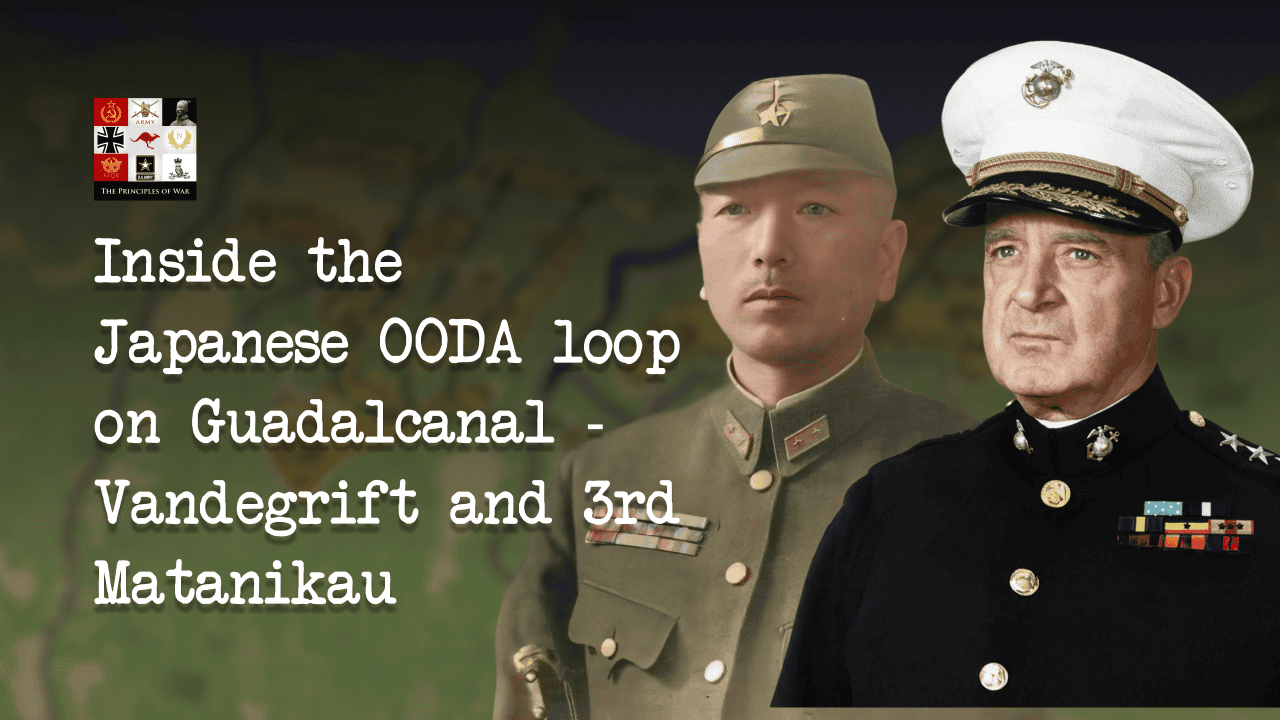





Maruyama vs Vandegrift in the fight to control the Matanikau River.
The 3rd Battle of the Matanikau Part I – This is the ninth episode of our Guadalcanal series with historian and author Dave Holland.
This episode continues the Guadalcanal series, picking up in the wake of the US Marine defeat at the Second Battle of the Matanikau. Both sides are racing to seize the initiative ahead of the planned Japanese October offensive. The Matanikau River sits as the key terrain for every operational plan on the island.
Japanese October Offensive Plan — Operation Ka and the Race to Reinforce Guadalcanal (00:00)
By late September 1942, the Japanese 17th Army was in a desperate race against time. Colonel Tsuji’s report to higher headquarters described the garrison on Guadalcanal as thinner than Gandhi — malnourished, attrited and barely combat effective. Yet Japanese operational ambitions had not diminished. Throughout the final days of September and into October, the Tokyo Express ran at full pace — destroyer after destroyer offloading troops and supplies under cover of darkness. The plan required mass — tanks, heavy artillery, whole regiments — and the Cactus Air Force was making large-scale daylight convoy operations suicidal. Admiral Yamamoto defined the primary mission of the Combined Fleet as support to the recapture of Guadalcanal, and the mechanism was a coordinated air, naval and ground assault on Henderson Field. X-Day was set for around the 17th to 18th of October. Everything else in the campaign flowed from that deadline.
Henderson Field as Decisive Terrain — Why the Cactus Air Force Shaped the Entire Campaign (03:50)
Henderson Field was the decisive terrain that shaped every decision made by both sides on Guadalcanal. The Cactus Air Force confined Japanese resupply to darkness and small destroyer loads, preventing the mass offload of heavy equipment the 17th Army needed. Fast transport convoys could not operate within range during daylight without accepting catastrophic air attack. To break that stranglehold, the airfield had to be suppressed or destroyed before X-Day. The artillery plan, the Matanikau offensive, the battleship bombardments — all were in service of that single requirement. Control of the air over Henderson Field was the campaign’s defining constraint.
Pistol Pete Explained — Japanese Heavy Artillery and the Matanikau Artillery Platform Plan (07:50)
The plan to suppress Henderson Field centred on a ten-day artillery bombardment using 150mm howitzers and 100mm cannons — the weapons the Americans collectively nicknamed “Pistol Pete.” Pistol Pete was not a single gun but a collective name applied to any Japanese artillery piece that struck the Henderson perimeter, from light infantry guns all the way up to the heavy howitzers. These large weapons were limited in mobility, never moved more than 300 yards from the coastal track, and required tractors and trucks to shift. The operational plan was to seize the east bank of the Matanikau, establish artillery firing platforms on the ridgeline, and bring Henderson Field under sustained suppressing fire from within easy range. Once the airfield was sufficiently suppressed, the fast convoy would run in, battleships would bombard, and the ground assault would go in. The Matanikau crossing was the enabling step for everything that followed.
The US Marine Plan for the Third Battle of the Matanikau (11:00)
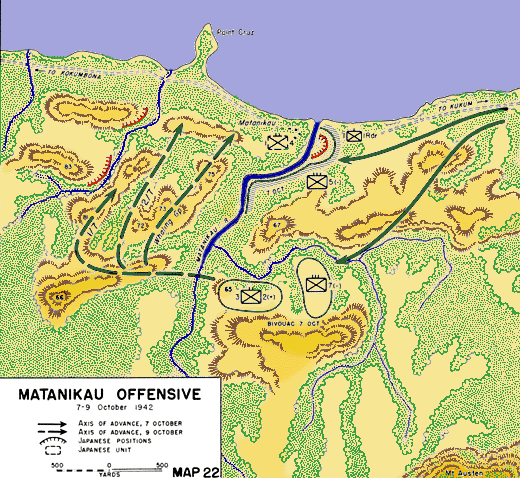
Recognising that the Matanikau was as vital to the defence as it was to the Japanese attack plan, General Vandegrift planned the largest offensive operation mounted since the initial landings. Approximately two-thirds of available combat power — around 4,500 to 5,000 men — was committed to the offensive, accepting significant risk to the Henderson perimeter at a time when Japanese reinforcements were arriving nightly. Two battalions of the 5th Marines would fix Japanese forces at the river mouth, while the 7th Marines and 3rd Battalion 2nd Marines crossed 2,000 yards upstream at the one-log bridge, swept down three parallel north-south ridgelines and trapped whatever Japanese forces remained west of the river. The Whaling Scout Sniper Group would lead the crossing. If successful, the advance would continue to Kokumbona — pushing the enemy eight miles from the perimeter — and establish a forward patrol base. The date set was 7 October.
Seizing the One-Log Bridge — Initial Contact and the Marine Envelopment, 7–8 October 1942 (18:40)
When the Marines stepped off on the morning of 7 October, they encountered a Japanese defensive posture stronger than anticipated. Major General Nasu’s 4th Infantry Regiment — fresh troops replacing the exhausted Kawaguchi force — had pushed a reinforced company 500 yards east of the Matanikau to a fortified choke point, with a second small group guarding the one-log bridge 2,000 yards upstream. At the river mouth, the 5th Marines spent the day pushing the Japanese rearguard back in a fighting withdrawal to a horseshoe-shaped defensive pocket on the east bank — roughly 100 men well dug in. Upstream, the Whaling Group used Solomon Islands scouts to find a crossing 200 yards above the bridge, outflanked the Japanese guard and secured the one-log bridge by early morning on 8 October. What made the timing extraordinary was that the Japanese 4th Regiment had independently planned to push across in force on the same day. The Marines beat them to the punch. The speed and scale of the crossing overwhelmed Japanese command and control, and their plan collapsed before it began.
Spoiling Attack Without Knowing It — Competing Plans, Monsoon Rain and Amphibious Deception (25:00)
The Third Battle of the Matanikau is a case study in the unplanned spoiling attack. Captured Japanese documents revealed after the battle that both forces had independently planned major offensive action for the same day. The Marines moved first, and simultaneous crossings at multiple points broke Japanese command and control before the 4th Regiment could mass. Then monsoon rain halted the Marine envelopment on the ridgelines. Vandegrift and his chief of staff Colonel Jerry Thomas debated whether to press on or call off the attack. Vandegrift pressed on — acutely aware that Japanese reinforcements were arriving nightly and that any delay would allow the trapped forces to escape. Overnight, Colonel Edson used a handful of amphibious tractors to simulate a second amphibious landing along the coast at Port Cruz. Despite the driving rain, Japanese reports recorded that they had beaten back an amphibious assault, and a full battalion spent the night marching and counter-marching against a threat that did not exist. An entire battalion was fixed out of the fight at virtually no cost.
Leadership Under Fire — Into the Valley by John Hershey (30:00)
The episode closes with a reading from John Hershey’s Into the Valley, a sixty-page eyewitness account written by a journalist embedded with a Marine company during the battle. The scene is a small valley on the east bank of the Matanikau, where the weapons company of 2nd Battalion, 5th Marines moves to envelop a Japanese position and runs into a crossroads defended by machine guns and mortars. Weapons jam. Men are killed and wounded. Fear becomes epidemic and the company begins to break. Captain Rigaud — described by Hershey as a boy with tired circles under his eyes — stands to his feet in full view of snipers and machine gun fire to halt the rout. Through a combination of blistering sarcasm, direct orders and forceful presence, Rigaud returns his men to their positions and puts them in a mood to fight again. Hershey observes that Rigaud was almost certainly just as frightened as every man around him. He showed nothing. The orderly withdrawal that follows — all wounded and equipment recovered — is a direct result of one officer refusing to lose control of himself at the moment his men needed him most. Into the Valley is worth reading in full. It is one of the clearest accounts in the literature of what junior leadership actually demands at the moment of crisis.
PME Discussion Points
1. Terrain and Operational Art
Both sides independently identified the Matanikau as key terrain. How do commanders identify and communicate key and decisive terrain to subordinates before it becomes contested, and what mechanisms exist in your planning process to ensure that recognition is shared across echelons?
2. Accepting Risk to the Main Effort
Two-thirds of available combat power was committed to Vandegrift’s offensive while a large enemy convoy was known to be inbound. When is it operationally sound to accept asymmetric risk to a defended position in order to seize the initiative, and how should that risk calculus be communicated to higher headquarters?
3. The Spoiling Attack
The Marine offensive inadvertently disrupted the Japanese timetable for their own crossing. What conditions create the opportunity for a spoiling attack, and how should commanders structure their reconnaissance and intelligence effort to identify those conditions before the enemy acts?
4. Deception on a Shoestring
A handful of amphibious tractors fixed an entire enemy battalion for a night at negligible cost. What does this illustrate about economy of force and the disproportionate effect of deception against an enemy whose command and control is already under stress?
5. Leadership at the Point of Crisis
Captain Rigaud physically intervened to halt a developing rout under intense fire. What obligations does a commander have to position himself at the decisive point when unit cohesion is breaking down, and how does a leader maintain the outward composure that Hershey describes when personally experiencing the same fear as the men around him?
Dave Holland is an ex-Marine and was posted to Guadalcanal with the Australian Federal Police. He regularly leads battlefield study tours through the area. He is a world-leading expert on the battles of Guadalcanal and author of Guadalcanal’s Longest Fight – The Pivotal Battles of the Matanikau Front.
https://www.patreon.com/cw/principlesofwar – if you’ve learnt something from this episode and you can afford it, please support the podcast at Patreon.
Great Professional Military Education for your Unit. This episode looks at seizing and retaining the initiative as a part of Offensive Action.


