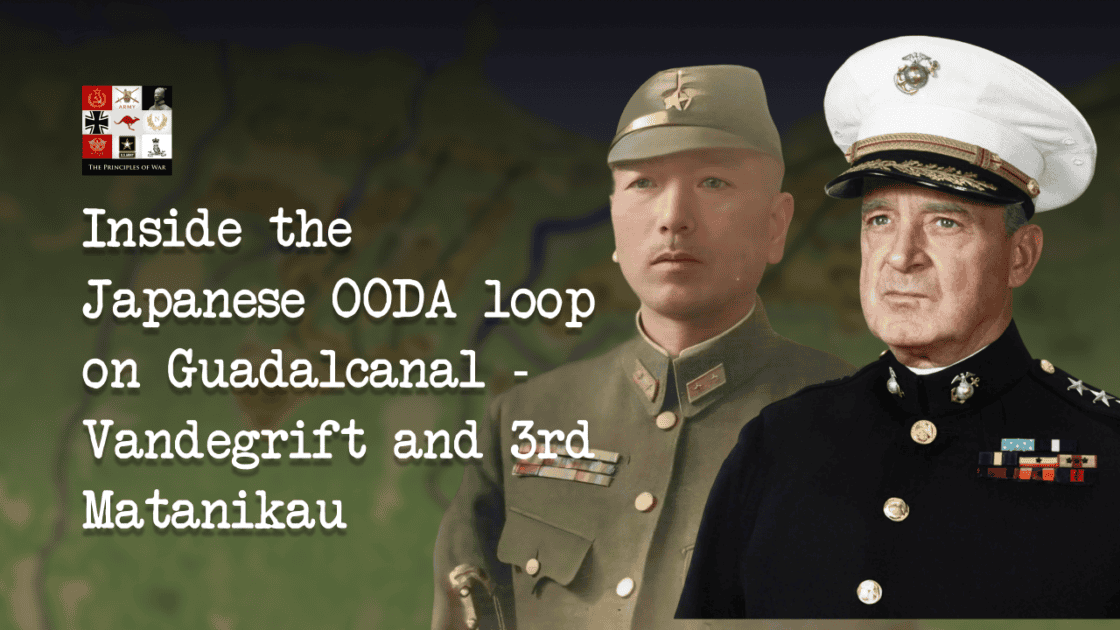
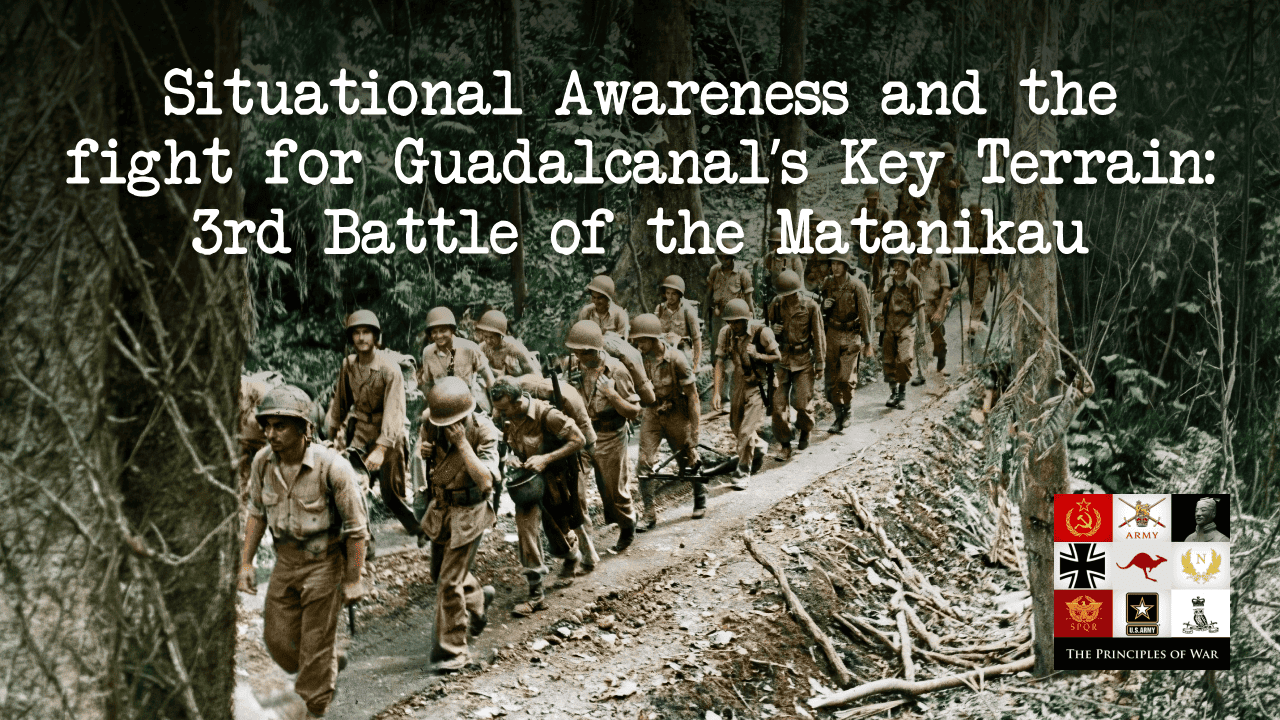





This is the tenth episode of the Guadalcanal series with battlefield historian and author Dave Holland. Picking up where Part I left off, the Marines have crossed the Matanikau inland and consolidated overnight on Hill 66 in driving monsoon rain. Part II covers the morning sweep down three ridgelines toward Point Cruz, the destruction of the Japanese 4th Infantry Regiment, the strategic consequences of that destruction for the October offensive plan, and Hyakutake’s arrival on Guadalcanal to personally command an army reduced to chaos before he had unpacked his kit.
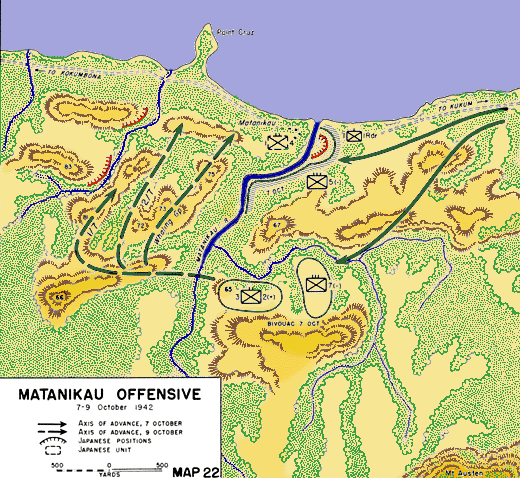
Sweeping the Ridgelines — The Morning Attack, 8 October 1942 (00:00)
After consolidating overnight on Hill 66 in the heavy rain that had broken the momentum of the initial crossing, the three Marine battalions moved to their assigned ridgelines at first light. Third Battalion, 2nd Marines would peel down the first ridge toward the mouth of the Matanikau. Second Battalion, 7th Marines under Lieutenant Colonel Hanneken would take the second ridge. Puller’s 1st Battalion, 7th Marines was assigned to cover Hanneken’s left flank and provide a backstop if needed. It was a textbook three-up advance down parallel axes, each battalion driving north toward the coast.
The Japanese 4th Infantry Regiment was already pulling back. By the time the Marines began pushing down the ridgelines, the regiment had lost the equivalent of three companies and had effectively ceased to function as an organised force. Japanese delaying teams with machine guns were left at key points to slow the advance. One of these teams halted Hanneken’s battalion with heavy fire, killing an entire squad. Puller detached a company to clear the position while continuing to engage from Hills 80 and 81. Third Battalion, 2nd Marines reached the mouth of the Matanikau and reported it clear. Second Battalion, 7th Marines drove through to the coast. The Japanese had gone.
Puller’s Ravine — The Myth and the Evidence (04:30)
The action on Hills 80 and 81 produced one of the most persistent myths of the Guadalcanal campaign. Puller’s scouts, positioned on the ridge crest, looked down into the covered ravine below and spotted a Japanese unit—the understrength 2nd Battalion, 4th Infantry, survivors of Edson’s Ridge who had landed with 740 men and were now at roughly 350—moving along the trail. They brought machine guns, 60mm mortars and 75mm artillery onto the column and worked it over for close to an hour.
The legend that emerged recorded 600 Japanese killed in that ravine. Holland has spent years cross-referencing the available evidence. Puller’s own initial reports gave his battalion’s losses as five, with Japanese losses at roughly five times that. A company commander’s report put the count at approximately 300 Japanese in the ravine. A sergeant’s account said 300 to 350. Japanese unit reports for 2nd Battalion, 4th Infantry showed they could not have lost more than 350 men total. The 600 figure appears to derive from a captured Japanese staff officer’s diary that recorded 700 losses for the entire 4th Regiment across the whole battle—and has been misread ever since as losses from Puller’s ravine action alone. Once Puller was told his battalion had killed 600 Japanese, he had no reason to argue the point. The Marines had been ordered out and the bodies were never counted.
Vandegrift’s Risk Calculus — Holding the Matanikau with a Three-Mile Gap (07:00)
As the ridge sweep was concluding, Vandegrift received intelligence that a large Japanese convoy was heading for Guadalcanal. He issued orders for the force to pull back and concentrate on defending the Henderson perimeter. Puller’s battalion was mid-engagement when the order came through. His regimental commander told him to break off. Puller radioed back that he was already in contact. “You can’t be,” came the reply. “Come up here and see,” Puller answered. The order to withdraw stood.
Vandegrift did not want to abandon the ground west of the perimeter entirely. In a calculated gamble, he left two battalions dug in at the mouth of the Matanikau rather than pulling everyone back inside the main defensive line. The decision created a three-mile gap between those forward battalions and the Henderson perimeter—a gap through which a Japanese force could have theoretically pushed to cut them off. Vandegrift accepted that risk because the Matanikau had been identified as the terrain that would decide the campaign. Losing it back to the Japanese immediately would simply invite a repeat of the entire fight. Artillery was positioned to support the forward position should it come under serious pressure, and as the next episode will show, the Marines turned the mouth of the Matanikau into one of the most heavily defended positions they held on the island.
Japanese Command and Control Collapses — Interior Lines Without Information (09:00)
The degree to which Japanese command and control had broken down during the battle is illustrated by a single fact from the unit reports. The 1st Battalion, 4th Infantry did not submit its emergency report of the day’s action until 1700 hours. That report did not reach the regimental commander until 0300 the following morning. A full day of combat—the destruction of multiple companies, the loss of the river crossing and the ridge system—was being processed through a command chain operating with a ten-hour information delay, on interior lines, with the enemy in contact.
Major General Nasu, commanding the 4th Infantry, issued orders that evening for a full-scale counterattack the following morning. Colonel Nakagawa, whose battalion had just had three companies wiped out, received the order and—understanding the actual situation—refused. He had thousands of Marines pouring down the ridges toward him. He was not going to attack. The resulting chaos of conflicting orders, delays in communication and commanders issuing instructions disconnected from battlefield reality paralysed the 4th Regiment at the moment it needed coherent direction most. This was not an isolated failure. It reflected a systemic problem with Japanese command and control at Guadalcanal that would persist and compound through every engagement that followed.
The communications technology itself was not decisively inferior—both sides relied primarily on field telephones and runners, supplemented by HF radio. What differed was the willingness and ability to pass bad news up the chain in time to act on it. A battalion commander’s reluctance to report a catastrophic defeat to his regimental commander is entirely human. On Guadalcanal, it was fatal.
Combined Arms — Mortars, Artillery and the Limits of Close Air Support (12:00)
The Americans brought a decisive advantage in fire support to the 3rd Matanikau. Each Marine battalion carried four 81mm mortars and a complement of 60mm mortars—the 81s positioned 300 to 500 yards back on reverse slopes where they could fire over the coral ridgelines, the 60s within 100 yards of the infantry. The difficulty of firing mortars in thick jungle, where the high-angle trajectory needed clearance the vegetation did not always provide, pushed crews into coconut plantation areas and open ridge backs wherever possible. Seventy-five millimetre artillery was called onto the ravine where Puller’s scouts had identified the retreating Japanese column.
The Japanese were not without their own fire support. The knee mortar—properly a grenade discharger—was issued at twelve per company, saturating areas rapidly with fragmentation. The 90mm mortar, roughly equivalent to the American 81mm and earning genuine respect from Marine veterans, was also in use. But the Japanese artillery proper had not yet been brought to bear. The heavy pieces that would ultimately attempt to suppress Henderson Field were still being moved into position. The artillery mismatch at the 3rd Matanikau was therefore primarily a comparison of organic mortar capability, and there the Americans held the edge.
Cactus Air Force aircraft—Wildcats, P-39s, P-400s and SBD dive bombers—were available for close air support but were constrained by the proximity of the opposing forces. With Marines and Japanese separated by only the 100- to 150-yard width of the Matanikau, striking forward Japanese positions risked fratricide. Air assets were directed instead against rear Japanese positions: reinforcement routes, suspected mortar positions and supply points. The result was that the most effective integrated fires in the battle were delivered not against the forward defences but against the Japanese logistics and movement corridors behind them.
One of the more unusual fire support stories from the battle involves Platoon Sergeant Mitchell Page—who would later earn the Medal of Honor in a separate action—positioned on Hill 49 on the east bank with four water-cooled Browning M1917 heavy machine guns. Page was engaging Japanese movement at ranges out to 2,000 yards, shooting indirect fire with the heavy machine guns across the ravine below. The image of four heavy machine guns on an east-bank ridge working targets on the far side of the river at that range gives some indication of the fire dominance the Marines had established.
Strategic Consequences — The Artillery Plan Unravels (15:40)
Holland’s assessment is direct: the 3rd Battle of the Matanikau was the most important land battle of the Guadalcanal campaign. The reason lies in what the Japanese plan had depended on. The ten-day artillery suppression of Henderson Field—using the 150mm howitzers and 100mm cannon that the Marines called Pistol Pete—required firing platforms on the ridgeline east of the Matanikau. Those platforms were now in Marine hands. The Japanese could no longer push their artillery to within five miles of the airfield.
Forced back to the Kokumbona area, the 150mm howitzers were now firing at ten miles—at or beyond their maximum effective range. A battery commander’s account recorded firing approximately seventy to eighty rounds from a single gun at maximum charge and maximum range before the weapon’s breech was damaged beyond further use. A 150mm howitzer that had been a critical campaign asset became, after less than a hundred rounds fired in anger, an immovable and useless piece of equipment. The lighter 75mm pieces the Japanese had intended to move forward with the 150s were now completely out of range.
Without effective artillery suppression, the ten-day bombardment plan collapsed. The plan had required that suppression to set conditions for the fast convoy operation and the battleship bombardments that would precede the ground assault. Those elements had not disappeared from the Japanese order of battle—but they would now have to carry a burden the artillery had been designed to share. The 17th Army planners went back to the drawing board. They could not push a division down the coastal bottleneck across the Matanikau with a hardened Marine position on the east bank and no artillery fire superiority to support the crossing. The October offensive would have to find a different axis.
Hyakutake Comes Ashore — Command in a Jungle Ravine (20:00)
Lieutenant General Harukichi Hyakutake, commanding the Japanese 17th Army, came ashore at Guadalcanal on the night of 9 October to personally direct what had been designated the most important operation in the Pacific theatre. He landed to find his headquarters staff in chaos and a panicked staff officer reporting that the 4th Regiment had been totally destroyed. The situation was not quite that dire—one battalion had been gutted and the regiment as a whole had been badly attrited—but it was bad enough. One of his main attacking units was gone before the October offensive had even begun.
Hyakutake established his headquarters at Kokumbona, accessible from the coastal trail via a jungle ravine with stream cover and adequate overhead concealment. His initial staff on the island numbered eleven officers. They were reinforced with a communications unit of approximately forty men and additional staff, eventually building to around sixty to seventy personnel—including two lieutenant colonels dispatched directly from Imperial General Headquarters in Tokyo, officially as liaison officers but widely suspected of being Imperial oversight agents embedded to watch the army commander’s performance.
From this position, Hyakutake was simultaneously directing the Guadalcanal offensive and managing the Japanese withdrawal along the Kokoda Track in New Guinea—including the fighting withdrawal through Templeton’s Crossing and Isurava—from what amounted to a tactical headquarters in a jungle defile, accessible by foot trail, without road access, under intermittent air attack, with severely constrained signals capability. By January 1943, when staff officers from the 8th Area Army arrived to assess the situation, Hyakutake had retreated from his bivouac huts to a cave beneath a tree root system in a stream bank. The physical environment of the Japanese high command on Guadalcanal was not simply austere. It was a direct expression of how comprehensively the Cactus Air Force had denied freedom of movement and assembly to any Japanese presence above ground.
Air Power as the Campaign’s Decisive Element (23:00)
The 3rd Matanikau brings into sharp focus what the entire Guadalcanal campaign was fundamentally about. Henderson Field was not just terrain—it was the unsinkable aircraft carrier that denied the Japanese daytime use of the sea approaches to the island. The Japanese Imperial Navy retained surface supremacy throughout the campaign. It won most of its night engagements. But it could only operate at night, which meant it could only deliver supplies at night, which meant destroyer-loads rather than transport-loads, which meant the numbers never came close to sustaining a 20,000-man army preparing for offensive operations.
The supply arithmetic was brutal. Fifty destroyers running at full capacity could deliver approximately two days of food. The heavy equipment—tanks, artillery, bulk ammunition, construction materials—required transports that could not operate within range of the Cactus Air Force in daylight. The Japanese had sufficient resources in their rear areas. They could not move those resources to the battlefield. Every operational plan that the 17th Army developed for October had to accommodate that constraint, and every plan was degraded by it.
The Pacific theatre dynamic that emerges from Guadalcanal is the inverse of the European theatre. In Europe, air and sea power existed primarily to support and enable ground operations. In the Pacific, ground operations existed primarily to capture and hold airfields that would extend the range of air power to the next stepping stone. The soldier and the Marine were fighting to defend the airfield. The airfield was fighting the real battle. Henderson Field was the campaign’s centre of gravity because whoever controlled the air over Guadalcanal determined who could supply their force, and logistics determined everything else.
PME Discussion Points
1. Command and Control Under Combat Stress
The IJA’s 1st Battalion’s emergency report took ten hours to reach the regimental commander. Japanese battalion commanders appear to have been reluctant to report catastrophic defeats up the chain. What structural, cultural and doctrinal factors combine to create this kind of information delay, and what mechanisms are used to ensure that bad news travels faster than good news in a degraded communications environment?
2. Holding Ground You Cannot Reinforce
Vandegrift left two battalions at the Matanikau with a three-mile gap to his main defensive line. The decision was operationally sound in context—the terrain was worth holding, artillery could support, and he accepted that the risk was manageable. What criteria should commanders use when deciding to hold exposed forward positions rather than consolidate, and how should that risk be communicated to subordinate commanders who may have to fight their way out unsupported?
3. The Limits of Close Air Support in Complex Terrain
CAS was constrained to rear-area targets because the contact line was too narrow for safe employment against forward positions. The effective approach was to use aircraft against logistics and movement corridors rather than the front line. This is not uncommon. The same occurred at Long Tan, and the Luftwaffe predominantly conducted deep strike to avoid fratricide in France in 1940. How does your planning process identify the boundaries of CAS employment in close terrain, and what doctrinal mechanisms exist for shifting air assets to shaping operations when direct support of the close fight is not feasible?
4. The Operational Logistics Problem
The Japanese had sufficient resources in their rear areas. Their failure was a delivery problem—they could not get what they had to where it needed to be. This is a fundamentally different problem from a production or procurement shortfall. In the operational context, where are the most likely delivery chokepoints in your logistics chain, and how should commanders at the operational level manage that distinction between having resources and being able to move resources? (The DAK in North Africa had a very similar issue – not enough trucks to move fuel to the troops at the front.)
5. Headquarters Size and Command Effectiveness
Hyakutake was directing a corps-level operation and simultaneously managing the Kokoda withdrawal from a headquarters of eleven officers, later expanded to approximately sixty personnel in austere jungle conditions. Small headquarters can be lean and agile; they can also be badly under-resourced for the cognitive and communications load they are asked to carry. What is the minimum viable staff for a corps-level operation in a degraded environment, and how do commanders identify when a headquarters has crossed the line from lean to under-resourced?
Dave Holland is an ex-Marine and was posted to Guadalcanal with the Australian Federal Police. He regularly leads battlefield study tours through the area. He is a world-leading expert on the battles of Guadalcanal and author of Guadalcanal’s Longest Fight – The Pivotal Battles of the Matanikau Front.
https://www.patreon.com/cw/principlesofwar – if you’ve learnt something from this episode and you can afford it, please support the podcast at Patreon.
Great Professional Military Education for your Unit. This episode looks at seizing and retaining the initiative as a part of Offensive Action.