





The Centre of Gravity is that characteristic, capability or locality from which a force, nation or alliance derives its freedom of action, strength or will to fight.
For the British, the CoG was the Singapore Naval Base. It was the fundamental part of the defence of the whole of South East Asia. In times of need the Royal Navy would sail out to Singapore and defeat all comers and ensure that the Empire was secure. The port at Singapore was central to the defence of Australia. The base wasn’t big enough for the fleet required to keep the seas free. The fleet was unlikely to sally forth if decisively engaged in Europe, so the fleet base was too small for a fleet that was unlikely ever sail there. It turned out to be the second largest graving dock in the world at the time.
We look at how the Singapore Strategy became increasingly untenable, but no one was prepared to
In 1940 it became apparent that the Navy would not be able to sail to Singapore ‘for the foreseeable future.”
LT GEN Percival conducted an analysis of the defence of Singapore before the war. This dictated that the defence of Singapore would need to be conducted in Malaya and northern Malaya at that.
As the war progressed, Churchill hoped that the US would provide the Navy required to support the British in the Far East, if provoked.
With no Navy to defend the base, the defence of Malaya fell to the Air Force. With not enough planes and the planes they had being too old, the last line of defence would be the Army.
The defence of the base dictated the way that the Battle of Malaya was fought.
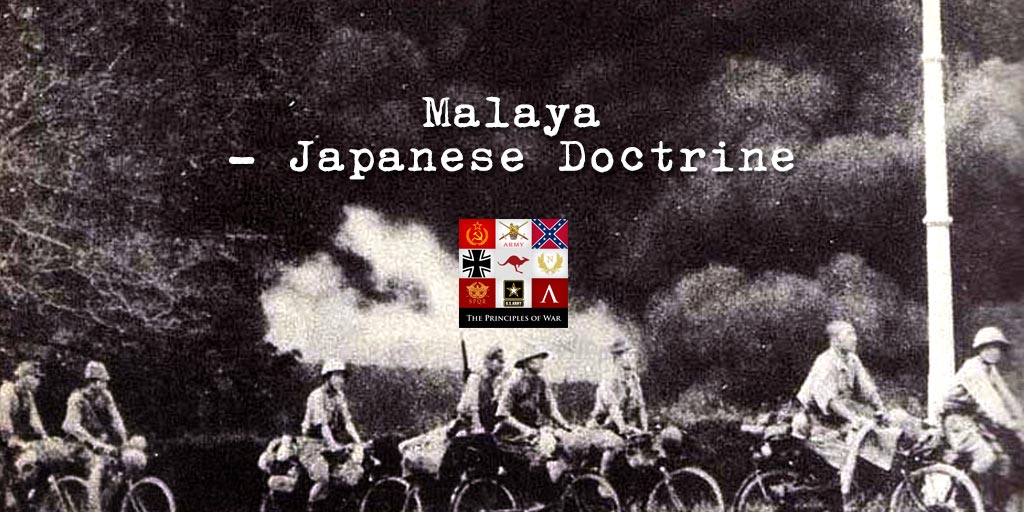
For the Japanese, the CoG analysis is a lot easier. It was the tank.
The tanks the Japanese had were not great and the tactics they used were not modern, but they had tanks, used them very aggressively and the British had no tanks in Malaya. The Japanese used the tanks for filleting attacks which were devastating, especially against forces that were not well versed in combined arms, or even anti tank weapons.
A Critical Vulnerability of tanks, of course, is the logistics tail required. How will Yamashita overcome this?
Transcript
Centre of gravity constructs for the Malaya campaign.
This is the Principles of War podcast, professional military education for junior officers and senior NCOs.
Okay, so from Doctrine, the centre of gravity is something that you should focus all of your actions on. The centre of gravity is that characteristic capability or locality from which a force, nation or alliance derives its freedom of action, strength or will to fight. At the tactical level, the centre of gravity will often change as the mission progresses and will frequently be determined by the interaction of enemy and friendly intentions. And as we know, the approaches to defeating the enemy’s centre of gravity are described as dislocation, disruption and destruction. Okay, so that’s what it says in doctrine. What we’re going to do now is unpack what I think the centres of gravity are for the British and for the Japanese in the Malaya campaign in World War II.
Now, many beers have been drunk in the mess debating the various of centres of gravity in various campaigns, and I may come up with something different for you. I think the most important thing with the centre of gravity construct is to remember that it’s a way of looking at either friendly or enemy forces. If you have a different centre of gravity, then you may or may not have different critical vulnerabilities which you’re going to target.
Often the choice of centre of gravity, particularly at a tactical level, is a moot point because your critical vulnerabilities are going to come out similar for different centres of gravity, which means that it’s much more important the way that you target those critical vulnerabilities rather than the centre of gravity that you’re targeting at a strategic and grand strategic level, which is where we’re playing today, it’s a lot more important to get the right centre of gravity because your critical vulnerabilities are going to be different. Now, I’m not saying that I’m right. I’m giving you my viewpoint on what I think it is and I’ll tell you why. I’ve come up with the centre of gravity as being as how I think it related to the campaign.
And the good thing about this is we’re doing it from a historical point of view so we can actually see the actual left and right of arc, the forces that were employed, and how the actual battles panned out. So it makes it a little bit. It gives you a different viewpoint. Certainly hindsight is 2020 when we’re trying to come up with centre of gravity constructs. It’s important to remember, though, that neither general Staffs back in 1942 would have been sitting around the table debating their and their enemy’s centres of gravity. But I think it’s a really useful tool for looking at the way that the operations have been conducted.
And I think particularly when you at Malaya, because the British had the wrong centre of gravity, like they now, whilst they wouldn’t have had it formally had a centre of gravity, what they were trying to do, the way that they were conducting the campaign, the forces that they were assigned were all bounded by their centre of gravity, that strategically and grand strategically they were looking at for Singapore. And it was wrong. So this is what happens when you get your centre of gravity construct wrong. So what was the centre of gravity for the British forces in Malaya? It was the Singapore naval base. It was given to them in orders, it was repeated in orders. It bounded everything that they were trying to do. They fought the way that they fought because of the Singapore naval base.
They had the resources that they had because of the planning around the Singapore naval base. And as we’re going to show as we tell this story, you’ll see that this is not the centre of gravity for the British forces. So the story starts back in 1921. Britain, being an island country, had always relied on its navy. The Royal Navy was quite powerful and the decision in 1921 was taken to defend the empire in the east with a base for the fleet to deal with any threat. In 1922, there were the Washington Agreements, and this restricted the US, Britain and Japan to a ratio of 5 to 3 by tonnage. Now, this is a little bit of a slight to the Japanese, so they’re also an island nation and they see themselves as an up and coming nation.
And, you know, they’d had, quite rightly, they’d had some pretty good against the Russians, and so they could see them as taking a bigger role to play on the world stage. The Japanese liberal civilian government at the time let the 5:5:3 ratio slide because what they were hoping to do was to make up for that with better trade. They didn’t want to go to war. War’s expensive, it’s messy. They were hoping to avoid that and they were hoping to really reap the benefits of being able to trade a lot more with the countries around them. Now the Royal Navy was reduced to 15 capital ships, which was bad for Australia, because we actually had to sink one of our capital ships because they were included in the tonnage for the Royal Navy.
And the Washington agreements and the Singapore strategy really became core issues for Australian defence policy. Now in 1919. And so we’re one year after the Great War, Great Britain was running with a 10 year plan. And that’s, you know, similar to a lot of countries. The annual defence budget was allocated based on the assumption that there would be no major engagement in the next 10 years. They’d settled on the plan for a fleet base to protect the empire in the East. And in 1923 they committed around half a billion dollars in today’s money to build a port. They decided that port would be in Singapore. But progress with the port was actually very slow. In 1929, Stanley Bruce, the Australian Prime Minister, warned that if the new base was not complete, then Australia can only regard herself as deserted by the Empire.
Half a billion dollars was to be spent on it, which back then was a significant amount of money, but not overly significant. There was a couple of issues that came from this. The naval base was not going to be large enough for the fleet. A fleet that was large enough and they were thinking sort of, you know, 10 capital ships to come out to intimidate whoever, most likely the Japanese, to intimidate the Japanese into not taking action. And the naval base wasn’t going to be large enough to have the 10 capital ships plus all of the attendant destroyers and resupply vessels and all of those that make up a task force like that. So this is where the strategy starts to unwind. The base isn’t big enough for the fleet that would be required to provide an active deterrent.
The second part of it is that under the Washington agreement, you’ve only got 15 capital ships. Now, I’ve just said that the Royal Navy thought that they would send 10 capital ships to deter the Japanese. That’s what they thought was required to be able to perform that mission. That only leaves five capital ships. So it doesn’t take too long before the Royal Navy becomes decisively engaged and is unable to respond to a threat in the East. And so the interesting thing is that this great fleet base in Singapore isn’t big enough to be able to take a fleet which probably isn’t going to be able to come out anyway, because it’s highly unlikely that the Japanese would attack unless the Royal Navy was decisively engaged.
So this is an interesting little catch 22 is that you won’t need the ability to deploy the fleet will deter anyone right up until the point where you can’t deploy the fleet, in which case the fleet is no deterrence whatsoever. But both Australia and Great Britain continued on with this story that the base at Singapore was the fundamental part of the forward defence of the Empire in the East. So the port was opened in 1938, and like all good defence projects, the cost on it absolutely ballooned out and it ended up costing about 60 million pounds, which is the equivalent to almost $5 billion now, so 10 times as much as they had planned on spending. Winston Churchill touted it as the Gibraltar of the east, and it was certainly an impressive piece of infrastructure.
It was the second largest graving dock in the world, which is kind of like a dry dock. But the interesting thing is, when it was opened and we’re thinking like this is a significant naval base, you would think that the fleet would turn out. This is 1938. Things are starting to get a little bit interesting in Europe. So it was actually opened by the governor’s yacht. That was the best thing that the Royal Navy could summon to open it. None of the big ships from the Royal Navy turned out. Two cruisers from the United States did, though. And I think that this is an interesting sort of portent for how the UK were hoping that this was going to go down, is that they were going to be able to provide protection for the Empire from an umbrella from the United States.
That became part of the strategy. The big issue that they had, though, was that Britain was affected by the Great Depression and also the politics both fed in to decrease the size of the Royal Navy. So you can almost view the economy as being the fourth arm of the armed forces. And if you sacrifice the economy, that creates significant difficulties for the armed forces. So you have this moral dilemma of politically preparing for a threat that hasn’t materialised yet. So how do you muster the support to stay in government that you need to stay in government, because that’s a politician’s job, is to stay in government. It’s very difficult to then spend on defence where you need to.
And this is one of the things that democracies often struggle with, is how do you build a force that can act as a deterrent, particularly in an increasingly threatening environment when the threat actually hasn’t materialised yet. Now, In Australia in 1937, the army was really quite concerned about this and they had concerns around the. This was all called the Singapore Strategy. So phase one was the period before relief, and at that stage it was 42 days. So that was the period that it would take for the Royal Navy to steam from Britain out to Singapore with an allowance for weather. And so Singapore was going to have to remain to defend itself for that period, the 42 days. And many Australian Army Officers wanted more local defence, understanding that the Japanese wouldn’t challenge the British unless the Royal Navy was decisively engaged.
And if they were decisively engaged, then the Royal Navy wasn’t going to come. Now, this situation, this worst nightmare, materialised in June 1940 in the Britain. It came out in a report. For the foreseeable future, we see no hope of being able to dispatch a fleet to Singapore. And in fact, on 28 June, Britain requested Australian assistance. So rather than us getting assistance from the mother country, it was the other way. They were asking us for assistance and this is when we started sending troops. And Royal Australian Navy ships then came under command of the Royal Navy. Now, the interesting thing for Malaya is that there was never a change in the intent of the mission. So it was always to protect the naval base at Sembawang in order to allow the Royal Navy to secure Singapore.
And the reason that this is, that I think that this is the centre of gravity, is that it dictated the entire way that Percival conducted the Malaya campaign. Because he needed to fight. He couldn’t just protect Singapore because the Japanese would be able to establish airfields and they would be able to bomb the naval base, in which case it couldn’t be used by the Royal Navy. So he had to defend in Malaya and he had to defend a fair way because of the range of aircraft. Now, as the situation continues to deteriorate in 1940, on 15 August, a report comes out from the Chief of Staff. The situation in the Far east in the event of Japanese intervention against us, primarily the security of India, Malaya and Australasia depends on our ability to control the sea communications leading to them.
The foundation of our strategy in the Far east must therefore remain the basing of an adequate fleet in Singapore. Until we have defeated Germany and Italy, however, or drastically reduce their naval strength, we are faced with the problem of defending our interests in the Far east without an adequate fleet. In the absence of a fleet, we cannot prevent damage to our interests in the Far East. Our object must be to limit the extent of the damage and, in a last resort, to retain a footing from which we could eventually retrieve the position when stronger forces become available. Now, that footing of last resort was to be Singapore. The British felt that an attack on Singapore would provoke a retaliation from the us, and the defences were formidable and would allow for serious reinforcement in the case of attack.
So, from a strategic point of view, why would you reinforce Singapore when there was an urgent need for troops and aircraft and materiel in other theatres. Now, Churchill thought that as long as the garrison was strong enough to hold the fortress and there was the deterrent of US intervention, the risk was acceptable and there was no need to defend all of Malaya. Now, this didn’t filter down in orders from Churchill to the Chief of Staff. Now, as the strategic picture in the east worsened in January 1941, the Chiefs of Staff agreed with Far East Command that reinforcements were required, especially for RAF Far east. Pulford wanted 566 first line combat aircraft. And the Chiefs of Staff replied that in Europe the RAF could prevail when outnumbered and stated that they thought that 366 first line aircraft would be enough.
At this point in time, RAF Far east had under 100 aircraft. Few of them were first line and none of them were fighters. So RAF Far east was really in quite a parlous state. Now this is a critical problem because the order of hierarchy, as far as the Singapore strategy goes, is the Royal Navy. So we are retaining the base for the Royal Navy to sally out and deter or destroy any attackers against any of the Empire’s interests in the Far East. Now, Pulford was manoeuvring the RAF to pick up the slack of what the Royal Navy was creating. So the Royal Navy had said that they weren’t going to be able to come out because of the war in Europe. And so he was saying that the RAF would be able to interdict any attacker whilst they were still at sea.
So rather than building up troops which were desperately needed in other theatres, aircraft would be able to do that job and to make it so costly that an attacker would be deterred. The RAF had a lot of ground to cover from where they were to the point where they would be a credible deterrence against any enemy. And one of the fundamental problems that they had was they significantly underestimated the Japanese. A lot of the racial prejudices came in. They didn’t think that they would be able to fly, they had poor eyesight, they wouldn’t be able to see at night all of this crazy stuff which they were about to be in for a huge shock once the actual war started, because they will find out just how effective they were.
But when they actually went to war, the RAF was still flying aircraft like the Vickers Wildebeest, which first flew in 1928 and was retired in 1942. And I think that was when the last ones were shot out of the sky in Malaya, a large slow biplane that was used for naval attack. And it was just the courage of the pilots to fly those aircraft is amazing. When you’re flying up against something like a Zero, which was infinitely more manoeuvrable, it’s just absolutely crazy. And Churchill really was of the opinion that the political situation in the Far east does not seem to require, and the strength of our air force by no means warrants the maintenance of such large forces in the Far east at this time.
So we have this concept of the period before relief that when the strategy was first created in the 1920s, they were looking at sort of 90 days, and that was then shortened to 42 days. And the plan was in 1921. So before the Washington agreement, they were looking at sending 20 capital ships. That’s the size of the fleet that they were planning on. In 1924, they shortened the period of relief down to 22 days, with an allowance for 14 days for bad weather, and they would send 14 ships. Then in 1938, that blew out to 70 days and they’d send seven to nine ships. In May 1939, it went to 90 days and they’d send between two and seven. In September 1939, it went out to one hundred and eighty days.
So Singapore would need to defend itself for one hundred and eighty days before the Royal Navy could come to save them. And the number of capital ships was tba. There was no idea how many ships they would be able to send after 180 days. And it was in June 1940 that they said, well, we’re not coming. So you’re left with this crazy situation where Percival is responsible to protect the naval base that wasn’t large enough for a fleet required to deter the Japanese and that the Royal Navy had no intention of using. And because the Royal Navy is not going to be coming to save Singapore, then it goes to the Royal Air Force.
But there was no discussion between the air force commanders and the army commanders, virtually none whatsoever, which creates a fundamental problem when you’re trying to synchronise a defence plan for Singapore. And this whole story about needing to defend the base, this continues on almost right through until the entire disaster unfolds. It dictated the way that Percival had to fight. He needed to deny territory to the Japanese so that they would not be able to fly from northern Malaya and attack Singapore. He needed to retain that terrain. So rather than fighting a slow withdrawal, trading space for time, so that more and more reinforcements could come in from Great Britain and Australia, rather than doing that, he needed to retain terrain that’s a lot more expensive defensive battle. And it was a battle that he didn’t have the resources to be able to fight.
And we’re going to go through a lot of the reasons that he had around that. This is a fundamental part of why the Malaya campaign went so badly. It was because they had the wrong centre of gravity. Now, what was the centre of gravity of the Japanese? Well, this is a lot less difficult to work out. Let’s go with something old fashioned, an oldie but a goodie. Tanks. Now, they had 74 Type 97 Chi Ha medium tanks, 85 Type 95 Har Go light tanks, plus another 37 in recon regiments. The Type 97 was not a good match against British tanks, so it wasn’t a strong tank. And the way that the Japanese employed their tanks was, let’s face it was a little bit old fashioned. It was kind of out of World War I.
And I suspect it was because they had an infantry centric army and doctrine hadn’t caught up with what was available with the technology that they had. So tanks were employed in an infantry support role, kind of like mobile pillboxes, which sounds very World War I. Now they had taken their tanks out and this had worked fairly well in China. So you’ve got to remember the Japanese army, by the time they invade Malaya, they have significant operational experience. They have some elite units who have been trained and blooded over years of combat in Manchuria and China. But the Chinese weren’t sophisticated when it came to armoured warfare. When they invaded the Soviet Union, it was a different story and the victories were a lot harder to come by and their doctrine hadn’t really caught up with them, but you have to remember that.
So Whilst the Type 97 wasn’t a good match against British tanks, the important thing to remember was that there were no British tanks in Malaya and they never got any. So they were all shipped to Russia of all places and into the Middle east to support operations there. It was deemed inappropriate to send armoured vehicles to Malaya and partially this was a belief that the tanks wouldn’t be able to operate that well. Well, the Japanese found that was simply not the case and they developed what they called a filleting attack, where a tank would. And you’ve got to remember that a lot of it was they were often road bound, so there’d be the swamp or rubber plantations on either side, which the tanks wouldn’t be able to manoeuvre in too well.
They would just barrel down the road and clear any opposition from either side and they would just keep on going. Keep on going, keep on going with very aggressive doctrine around maintaining the momentum of the offensive. When you don’t have significant amounts of armour to oppose you and when the enemy isn’t well versed in using anti tank weapons, then these kind of filleting attacks can work extremely well. And this is what Yamashita did. And often you had troops who had never experienced or hadn’t even seen a tank before. For some reason it was quite a secret that the Japanese were using tanks. This was within the British forces. No one seemed to be getting the word out that they had tanks.
So even weeks after they landed and they’d been using their tank successfully in multiple battles, there were still units that were deploying that were being told there is no expectation of seeing tanks or the Japanese don’t use tanks, which is just mind boggling. So they weren’t using their anti tank capabilities anywhere near as well as they could have. Now obviously the big critical vulnerability for tanks is the logistics problem that this creates. And Yamashita had to work with this. He didn’t have a lot of them, there wasn’t a huge number of tanks, he only had a couple of hundred. But even then they’re incredibly thirsty and he worked aggressively to be able to maintain the logistics train that was required to maintain his tanks. Now the other thing that his tanks had going for him was that they were only 15 tonnes.
So they’re not incredibly heavy tanks which was really important for him. His force was engineer heavy because they needed to build a lot of bridges. There was a lot of rivers in Malaya and when you’ve got a tank that’s doing 15 tonnes it makes it a lot easier for your engineers to be able to build bridges to replace the ones that have just been blown up, to be able to get your tanks where they need to go. So you’ve got a. And the thing that I find absolutely amazing is that you’ve got the British with their left and right of arc defined by a centre of gravity that is no longer appropriate for their forces. And you’ve got the Japanese with a very traditional centre of gravity, a strong weapon system to which the British aren’t really able to counter.
And this is the thing that’s interesting about the centre of gravity construct. It’s the interplay between the two centres of gravity. That’s where all of the excitement happens. And this is why the British suffered so much. They couldn’t give ground, they couldn’t continue to conduct a delaying withdrawal. They, they needed to put in static defensive positions which were easily outflanked. And when they weren’t postured for a tank threat, these significant defensive positions just crumbled. And time and time again, we see positions that may or may not have had some time put in for them. We’re going to talk about the work that the engineers did or didn’t do in Malaya in one of the upcoming podcasts. But troops that weren’t prepared for them, weren’t trained for them, were just not able to withstand the tanks as they came barrelling down the highway.
And this was a significant factor in a lot of the victories that the Japanese had. And those victories fed on the morale effect, fed on the fears of the British commanders as they tried to sleep at night. This is what got within their OODA loop. This is what created the nightmare, and this is what destroyed their morale and created the turbulent and rapidly deteriorating situation with which they could not cope. So that’s it. I’m keen to hear what you think the centre of gravity was in Malaya, and hopefully I’m not too far off the mark. I think it explains a lot of the problems that the British had in Malaya when you think about how they were restrained in what they could do because they needed to protect the port.
And of course, you know, it’s very interesting looking at the way that the Japanese use the tanks, and I think even more interesting the way that the British failed to prepare to defend against tanks time and time again. The next podcast we’re going to cover the terrain, both physical and human terrain in Malaya, and we’ll probably get into having a quick bit of a look at the doctrine that both sides use, because there’s a significant difference here. And once again, that’s a little bit dry when you think about using doctrine as a force multiplier. This was a force multiplier for the Japanese. Fundamentally, it was well researched. The way they came up with it, the way they disseminated, the way they enacted it, their doctrine really was a force multiplier. So we’re going to look at that as well.
I hope you learned something today that’s going to make you a better leader and look forward to the next podcast, the Terrain of Malaya. Bye.
The Principles of War podcast is brought to you by James Ealing. The show notes for the Principles of War podcast are available at www.theprinciplesofwar.com. For maps, photos and other information that didn’t make it into the podcast, follow us on Facebook or Tweet us at surprisePodcast. If you’ve enjoyed this podcast. Please leave a review on itunes and tag a mate in one of our episodes. All opinions expressed by individuals are those of those individuals and not of any organisation.



5 comments
This is brilliant. I wish I had found if earlier!
Hi,
Thanks for the podcasts. I just completed the Long Tan series. I had some questions not covered.
1. After Long Tan was there a move to improve the functionality and preparedness of the other companies in the battalion. Was a similar process also determined for 5th RAR which if I remember was there at the same time?
2. How much did the SAS follow up the retreating NVA? I think this was covered a bit but to me the follow even weeks afterwards would have been pivotal.
3. How much of the lessons learnt filtered back into battalions earmarked for the next rotation in? Including as far as standards.
4. Was 5th RAR in a position to cut off retreating NVA? If I remember they were out on operation.
6. Where did Harry Smith end up career wise?
7. I always viewed the battle as well trained soldiers and junior leaders (I place majors also in that category) compensating for higher level unpreparedness and insufficient planning for task force Preparedness. Is that fair for the Australian task force in the early days? Based on the history of NVA and VC operations they had significant mobilization, movement, and fast strike capabilities at that time.
Regards,
Blott
Hi Steven,
We’ve just published a series with Harry Smith, which answers some of the questions.
There was quite a change as 1 ATF realised what a near run thing it was.
I am not aware of any efforts from the SAS to follow up the NVA.
The Hand over / take over was not great, so a lot of learning was redone as new battalions came into the AO.
Not sure here 5 RAR was, but I don’t think they were in position.
Harry ended up as a LT COL. He now spends his time sailing up on the Queensland coast.
1 ATF certainly could have done more, but I think it is easy to train a Coy, rather than a TF HQ. The lads were extremely well trained and I think that is where most of the lessons should be learnt. There was more the TF could do, especially around Int, logistics and battle management, in my opinion.
Dear James
Great work! I’m going to recommend this series to my fellow non-military students attending my current strategic studies masters. Clear and well presented.
Were tanks THE COG for the Japs in 1942? I agree that, indeed they were a COG… but not THE COG? If you take armour away, there was still Japanese aggression, amphibious outflanking moves ( never done once by the British + Empire forces), constant presentation of ‘multiple dilemmas to the enemy” ( to paraphrase TRADOC MDO jargon) ,and Japanese control of the air. I think Japanese use of manoeuvre theory and leadership was closer to the actual COG. Where the Allies employed 40 mm AT guns, as the Australians did at Bakri ( =please correct me if I’m wrong, its the action with the well-known film) the Type 97’s proved to be pretty vulnerable; and I’m not sure if the Boys AT rifle could penetrate the front armour but my wild guess is it would have gone through the sides: and both weapon systems were present. One wonders if things would have been different with a few squadrons of Matilda II’s?…..However given British leadership, training, lack of air power, and inter-service issues the outcome would probably have been the same in the end.
Thanks again for all your great work!
[…] would have dire consequences for the RAAF and the nation as decisions would be taken to support the Singapore Strategy, and would be considered from the point of view of Britain, not that of […]