





The British planned to use Artillery and Air Power to defend Malaya.
Malaya is hot and humid and it has the 29th longest coastline (lots of areas for conducting amphibious operations). There is a steep mountain range splitting the country between the East and West, and there are very few laterals over the ranges.
The road infrastructure improved over time to support the rubber and tin industries in Malaya and this enabled easy road movement. They are often 2 lane highways and in a large number of places the roads are cut into the hills forming defiles, perfect for the defence.
The Air Force constructs a number of airfields. Little consideration was given to the provision of local defence for these airfields. This dictates the ground that the Army is required to defend.
The human terrain consists of British expats, Chinese, Malays, and Indians. The Chinese are very co-operative with the British, but the Malays, who are exploited as cheap labour, are more co-operative with the Japanese. Cheap wages for labourers create discontent among the Malays and Indians. The Indians, being exploited for labour, this increased feelings of Indian Nationalism.
Racism exacerbated the tensions between the Indians and the British. Britain relied on a massive expansion of the Indian Army. The IIIrd Indian Corps had a lot of junior, poorly trained troops.
In Australia, there was a pool of 80,000 in the Commonwealth Military Force. This pool created 6th Division, 7th Division and 8th Division. Eighth Div would provide the troops from Australia who would serve in Singapore and Malaya.
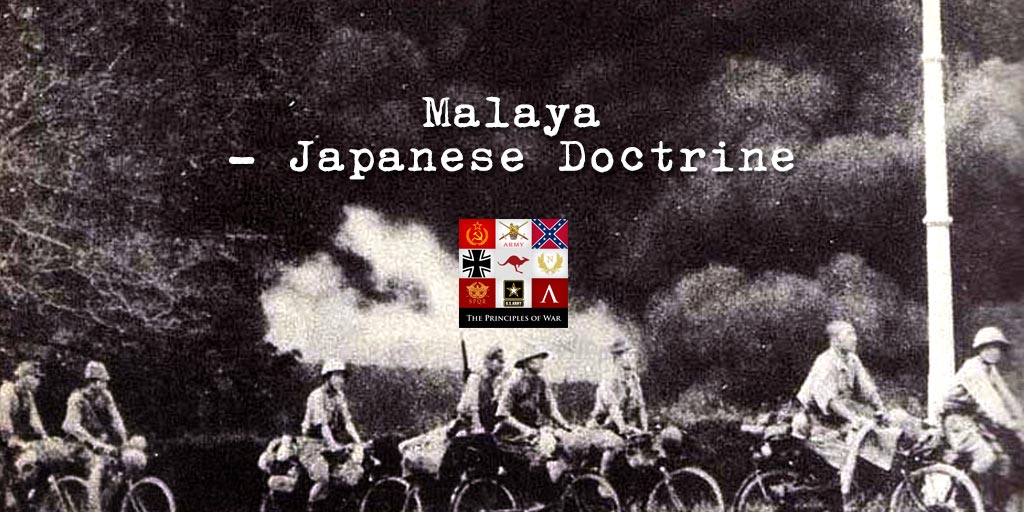
The Japanese had been our allies in WW1. We discuss the Marco Polo incident and the experience that the Japanese troops had prior to the invasion. The Japanese had been on a war footing for a long time and their Army was much better trained and equipped.
We ran out of time for Doctrine. Next episode we will try to make the doctrine interesting, if not fascinating!
Transcript
The Malaya Campaign to Reign and comparing Allied and Japanese doctrine.
This is the Principles of War, Professional military education for junior officers and senior NCOs.
Welcome back, everyone. So last episode, we looked at the centres of gravity. We came up with a little bit of an unusual centre of gravity being the port that no one was going to use as being the centre of gravity for the British. And let’s see how that pans out over the next few podcasts. This podcast, we’re going to look at the terrain, both physical and human. And I think there’s some interesting stories in the human terrain that we can pull out, which had a significant effect on the Allied campaign. And then we’re going to look at the doctrines of the Japanese and the British. And I think that this is really interesting. It sounds really boring when we go comparing doctrines. Now, the Chief of Army says that we should look at doctrine as a journey rather than a destination.
And LWD1 says that effective doctrine should be constructed from three past experience, operational requirement and technological feasibility. So what we want to do is we want to have a look at the doctrines that both armies were using and see how well they operate against those criteria now. So when we look at the terrain, the first off we’re going to say is, why are we fighting in Malaya? Now, the answer to that was to defend Singapore. Percival had realised that in order to protect the naval port at Sembawang, which is on the northern edge of Singapore, it was necessary to deny the ability of the enemy to interdict the port or destroy the port with either artillery or air power. So artillery is relatively easy. You just need to deny them the range of the artillery pieces.
Air power is a lot more complicated because it means that you’ve got to push a lot further distance, and that effectively meant that they needed to defend all of Malaya. Now, the question before that is, why Singapore? So why did they put a base in Singapore? And this was defend the Far East? So we spoke in the centre of gravity that the Royal Navy was going to send out a fleet to deter or destroy any enemy that would want to interdict the empire in the 20s. They were looking at where they were going to put this port. So they looked at Hong Kong, but that was far too close to Japan and Taiwan. So Japan had occupied Taiwan since 1895 and that proved to be a really good choice, because as the Japanese moved down through China, they got very close to Hong Kong.
Sydney was also considered as a possible base, but it was too far away from what needed to be Protected. So they looked at Singapore, which was the perfect place because it’s in between Hong Kong and India. They can create a fleet base there and it’s central to the Eastern empire. So it’s 3,000 kilometres to Taiwan, 4,300 kilometres to Japan, which is a fair way away. That provides them a little bit of depth, a little bit of forewarning. 1300 kilometres to Cam Ram Bay in Vietnam, which is where the Japanese would end up basing some of their assets. 3,900 kilometres to India and 3,500 kilometres to Darwin. So really centrally located in the Asian area, close enough to be able to influence events. Not too close that it will be quickly overrun. So what is Malaya like now?
For the purposes of this, we’re just looking at peninsular Malaysia, which is the bit in between Thailand in the north and Singapore in the south. We’re not concerned with the other part, which is part of Borneo. Malaya is. It’s close to the equator and it’s quite hot and humid throughout the year. Average rainfall is about 250 centimetres in a year and the average Temperature is about 27. Now it’s got the 29th longest coastline in the world, which means there’s a lot of places that you could land if you wanted to conduct amphibious operations. Malaya is around 740 kilometres from north to south, and at its maximum width, it’s about 320 kilometres wide. It’s really quite mountainous, with about over half of the terrain 150 metres or more above sea level.
And harbours are on the western side of the country, which is where most of the population is, and that’s where Kuala Lumpur is, which is the capital. There’s a large mountain range which runs north, south, down the length of the country, and that effectively cuts the east and west coast in two. And that’s the Crocker range. Very steep terrain, very difficult to get across. And one of the important things, one of the big strategic terrain features, is that there are very few laterals. So you’ve got roads running down each side of the coast, the east and west coast, but very few laterals in between. So it’s actually hard to switch your emphasis across. Between the east and west coasts, the jungle is very thick, and in the lowlands it tends to peter out and turn into swamp.
The other major land use is for rubber plantations. So a lot of mountainous terrain, which is effectively impassable, which leads into, on the east and west coasts, predominantly swamp area. Now, the initial appreciation of the terrain was conducted in the twenties by the British. So that they could get an understanding of how to defend Malaya. The road network back then was fairly rudimentary. There was little railway infrastructure. But it’s important to remember that at the time, Malaya was producing almost half of the world’s rubber and 60% of the world’s tin. And this was a huge cash cow for the British. So British companies were making a lot of money out of it and it was a significant strategic resource.
Particularly as the world economy was moving out of the depression and starting to gear up for war, demand for rubber increased massively, the price increased massively, and so a lot of work was put into building the infrastructure to be able to get the rubber and the tin from the plantations and the mines to the ports where they needed to go. So the road infrastructure and the rail infrastructure was significantly improved in those 20 years. And initially it was thought that because of there was so much jungle that tanks wouldn’t be particularly appropriate in the jungle. With the lack of roads, they were going to find it difficult to be able to move. However, as the road network improved, the opportunity for fast movement by vehicle increased dramatically.
And that’s going to have a significant impact not only on where the battles occurred, but how those battles were conducted. Now, the other thing that is significantly impacted where the battles were fought, because you’ve got to remember one of the good things about the defence is that you get to pick the ground, hopefully where the defensive battle is going to be conducted. So there might be strategic reasons where a defensive battle needs to be fought, but as the commander on the ground, you get to pick where you’re going to put your divisions, brigades, battalions, companies, platoons and sections. So you’re obviously going to pick the best ground that’s most appropriate for you and the way that you want to fight.
And this is why attackers need a 3 to 1 ratio, because of the fact that they’re going to be moving into a defensive position that’s been chosen by the defender and they’ve got prepared defensive positions and they will have picked the ground that works well for them. So for the British, where they were doctrinally still thinking about lots of firepower, fixing the enemy, then destroying them with artillery, of course you’re going to want big open areas with really good fields of fire. Now, there’s one tiny problem with that. So right up until the last couple of years before the invasion, it was thought that the Royal Navy was going to defend Singapore, which is great, except when they say, well, actually we’re not going to be able to do that.
We’re tied up in Europe and so we’re not going to be able to send a fleet out to Singapore. At which point the Air Force sticks its hand up and says, that’s ok, because we will do the job. And of course they request funds, they request aircraft and they go out and build a whole heap of airfields and they build them with the sole consideration of being where would be the best place to put an airfield to attack the enemy as they come steaming towards Malaya and Singapore. There is no consideration put towards the local defence of the airfields. So, and whilst in hindsight you might think that’s a considerable omission, I think you have to remember that the Air Force still was very much a developing doctrine service. The role of air power was very new.
And on top of that, the last time it was really used in anger, which obviously was World War I, there had been significant technological advances providing much greater capability for air forces. And so, and we’re going to look at a few of the things, the way that the technology has changed or had changed up to that point, and how it surprised some of the commanders. But local airfield defence probably wasn’t really thought of very well. And that’s going to create problems because it’s dictating the ground on which the army needs to fight, rather than the army picking ground that it wanted to fight on and then placing airfields around them. Because you’ve got to remember too, airfields, it’s not a local defence area issue. It’s not something where you put a couple of platoons on the wire and say this airfield is defended.
Obviously there’s the flight paths into and out of the airfield as well, which need to be protected as well. Now the roads in Malaya, a lot of them are two lane highways. They’re very good roads. And in a lot of places they’ve been cut into the hills. So you’ve got these nice long, and in some cases kilometres long defiles where very steep banks on either side of the road makes for nice easy driving as you’re taking a Sunday country trip. Obviously it makes a perfect ambush site and is really quite easy to defend. And now a lot of the bush has been taken back from the roads. But in 1940, in a lot of places the jungle went all the way up to the edge of the road. So very easy to get very close to the road.
When we looked at the equipment that the armies had, the British army had 15,000 trucks. So very much an army that was prepared to use the road network much less so comfortable in moving off the road network. Now, when we look at the human terrain in Malaya, it’s really interesting. So there’s obviously the expat community of British and other colonials who are really sort of running the country, and a lot of that is around the export of tin and rubber. And so looking at the different population groups, there are native Malays, there is a lot of Indians, Tamils as well as Chinese. Now, each of these groups had some fairly different perspective of life in Malaya. So the Chinese.
And as we get closer and closer to the invasion, the Chinese become increasingly concerned about the Japanese because obviously there’s been a large war being fought in China, so they are very concerned about Japanese imperialism and really quite willing to assist the Allies in the defence of Malaya. It’s not quite as simple as that, because there’s Nationalist Chinese as well as Communist Chinese, and the Chinese party is outlawed by the. By the government. A lot of arrests occur and they’re often deported to China, where they are given to the Nationalist government and often executed. So it’s a complicated relationship with. With the Chinese. The Malays are exploited as a cheap source of labour in the tin mines and the rubber plantations.
And the interesting thing here, when you look at the Malays as well as the Indians, because there’s a large number of Indians who come out from India to work in Malaya, partially driven by droughts india and the lack of work there. So they come out as cheap sources of labour. Now, the government’s imperative is to continue operations in the tin mines and the rubber plantations all the way up to, and probably even after the invasion. That’s their main effort, which seems quite bizarre, particularly after the invasion occurs. And they want to do that as cheaply as possible. So the wages are incredibly low for the labourers. They’re so low, in fact, that the Indian government stops migrants leaving India to come into Malay for a period of time.
Whilst there’s an investigation about the low wages, there are multiple unions that are created, often by the Communist Party, the Malay Communist Party, and there are often strikes as well. And these strikes can be quite protracted, lasting a long time, and in some cases, the army is brought in. Now, the army that is in Malaya is predominantly Indian. So you’ve got multiple examples of where Indian troops are being forced to quell strikes and the striking workers are predominantly Indian. And in one case, one of the strikes ended with five strikers being shot dead by an Indian unit.
So this creates a huge amount of tension between the Malays and Indians one side, as the Exploited workforce and the government on the other side after the invasion, the Malays are very comfortable in supporting the Japanese army and they will provide them with information about the location of troops, caches, any information that they can give them. And they really bought into this idea of the Greater East Asia Co Prosperity Sphere, which was Asia for the Asiatics. And this is what the Japanese were pushing. They were pushing this story of they wanted to move away from imperial domination and that it was their countries and together they would all be able to be more prosperous. For people who were working very hard in tin mines and being paid very low wages, this story really resonated.
And in particular, when you look at the Indian labourers and the Indian army, one of the things that the Japanese were trying to do is to actually subvert the Indian army. They created the Indian national army, which is where they took troops who had surrendered and armed them to fight for Indian independence. Now how successful would this be? Well, you need to look at the way that the British ruled india and there’s a couple of fairly unsightly events that occur back india’s history. But one of the things that I think is really telling is that the way that the Indian regiments were, there was a lot of British officers who would, you know, so typically the CO and a lot of the captains and majors would be from Britain.
The good officers would make a significant effort to, they would learn the language so that they would be able to speak to their troops in their own tongue. Not all of them tried to do that and that created problems. But one of the things was that there were some junior Indian officers and there were a whole range of clubs. So obviously mess life was a significant part. And particularly before the war there were elements of a bit of a holiday type environment in Malaya. One of the issues that they had was that I was reading about there was a swimming club, so there’s a big swimming pool where everyone, all of the officers would go in the afternoon. They tended not to work too hard in the afternoon because it was a little bit hot and it was white only.
So you have this really harsh divide where you’ve got junior officers in a unit that you’re posted to that you’re expecting to act as officers and, you know, do all of those sort of things that you would expect, provide leadership to the soldiers, but they can’t go swimming with you because they’re black. And I think that this is one of the issues that sort of creates a really problematic undertone for the long term employment of the Indian troops. One of the other issues that the Indian troops had is they were the product of a massive expansion of the Indian Army.
So as the empire was gearing up for war and it became increasingly likely that Britain was going to struggle on its own resources and it was putting the call out to the empire to come and save England, there was a massive expansion of the Indian Army. So a lot of the troops were not well trained and a lot of them were very young soldiers. So this starts to really create this interesting dynamic, particularly in the third Indian Corps, which was the made up the bulk of the troops that were defending Malaya.
Now, I haven’t done a lot of research into what the expansion of the Indian army, what sort of effect it had on the calibre of the divisions that it was able to produce, but there’s been quite a bit written about the expansion of the Australian army in response to Britain’s call for assistance. And so prior to the war There was about 80,000 troops in the CMF, the Citizens Militia Force, and these were spread across the five infantry divisions and the supporting arms. Now, under the Defence act, these troops couldn’t be sent overseas. So it was decided to create the 2nd AIF. And on 28th September 1939, the 6th Division was re raised. They went on to form the seventh Division as well. And as the situation continued to worsen, it was decided to raise a third AIF division.
And this was the eighth Division and these are the troops that we’re going to be looking at in much more detail. So sixth and seventh Divisions went to the Middle east and fought very well over there. Now, obviously the vast majority of the troops came from the cmf, so people volunteered to join the second AIF from the CMF and which was what it was effectively designed to do. The problem was that across the 80,000 people that they had in the CMF, by the time they had fully equipped two divisions to go overseas, the talent pool was significantly depleted and it became very difficult when they were raising the eighth Division to be able to find people to fill the roles, particularly roles like Infantry Battalion Cos criteria was set out and this was done by Major General Vernon Sturdee, who was the div commander.
Now he wanted his COS to be. He didn’t want them to be too old, so he wanted them to be less than 45. He wanted them to have significant experience from the First World War and ideally they would have continued on in their military service in the cmf and he couldn’t find Anyone who met that criteria. So all of the COs that he appointed were a compromise. Some of them were provided outstanding service, some of them not so much. And we see this as well as brigade commanders. And even when we start looking at Major General Gordon Bennett, we start to wonder about what the talent pool was like when they were forming the eighth Division.
But it really does raise an interesting question when you’ve got a talent pool of about 80,000 people and then that contracts down to about enough talent to be able to equip fully two divisions. That does make you wonder about the ability to scale rapidly an army in the face of a rapidly deteriorating strategic picture now looking at the enemy. So the Japanese were approaching this from a very different standing start point. They’d actually been allies In World War I, the Japanese Navy had provided troop escorts in World War I. They’d suppressed an Indian battalion mutiny in Singapore in 1917. But they had become increasingly militaristic. There was a coup in Japan where the hawks within the military were able to gain more control. They started a war with China. So they invaded Manchuria in 1931. There was continual border skirmishing after that.
And then in 1937, they engineered an incident called the Marco Polo Bridge Incident, and that led to a full fledged invasion of China. This meant that when they conducted their invasion, they were using battle hardened divisions, extensive experience. They’d already been fighting for a couple of years, so their doctrine was well tested and it had been tweaked as they were moving forward. Because they were militaristic, their economy was more on a war footing. So their economy was a lot smaller than particularly the United States. And that was the fundamental issue that they were going to have. But there was a lot more technological advancement. Some of their weapons were particularly things like their torpedoes were the best in the world at the time. And so they’d been on a war footing.
They had a significant advantage in both from a technological point of view, from a doctrinal point of view, and from a training point and leadership point of view as well. So I think I might leave it there. We’ve run out of time to talk about doctrine, but what we have done is we’ve had a look at the physical terrain that the battles are going to be fought over. So predominantly jungle with some open spaces towards the coast and some nice roads running north, south with very few laterals. We then had a look at the human terrain, and I think this is an area that far too many people have been looking at. When you look at some of the problems. So as part of the research for this I listened to some podcasts that were just about Malaysian history and these Labour issues.
The role of the Malaysian Communist Party, it’s a lot more fundamental than the military histories give them pay attention to, particularly when you’re looking at the interactions between the civilians and Australian troops. Talk about it. We didn’t have, we didn’t interact with the civilians very much and it was because they didn’t really trust them and they didn’t trust them because of these issues with which the way that the civilian population had been treated. And this really comes back to that whole of government approach and I think that it had been fairly short sighted and everything was banked on the fact that no one was going to invade, particularly the Japanese weren’t going to invade. So we may as well get absolutely everything we can out of the natives. And it was really quite a short sighted approach.
The other thing that’s quite interesting about it is the whole lack of any integrated CIMIC type approach. So there’s no real setup for interaction between the military and the civilian apparatus of government. So there’s a walk council and the Governor of Singapore sits on that. But there was very little interaction between the military and the civilians and a lot of it came about because of the poisonous atmosphere amongst the civilians to the ruling British government. So in the next episode we’re going to dive right into the doctrine and there’s some really interesting stories which are going to further uncover the reasons why the Japanese were able to take Malaya just so quickly. So that’s it. Stay tuned for the next episode.
The Principles of War podcast is brought to you by James Ealing. The show notes for the Principles of War podcast are available at www.theprinciplesofwar.com. For maps, photos and other information that didn’t make it into the podcast, follow us on Facebook or Tweet us at surprisePodcast. If you’ve enjoyed this podcast, please leave a review on itunes and tag a mate in one of our episodes. All opinions expressed by individuals are those of those individuals and not of any organisation.