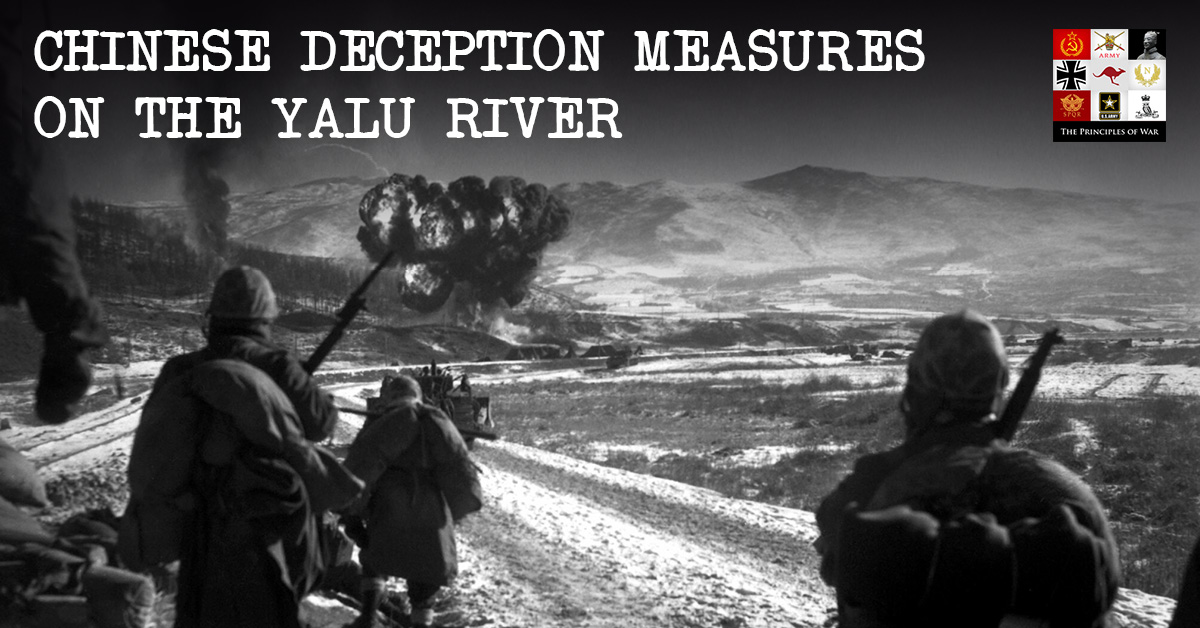





What role did Chinese deception operations play on the Yalu River in 1950? This is part 2 of our look at Chinese deception and US self deception on the Yalu River in the Korean War.
How did a dismounted and logistical challenged force with minimal air support outmaneuver UN force on the Yalu River in 1905? The PLA was able to achieve operational and tactical surprise with deception operations. This episode looks at PLA deception operations then and contemporary PLA deception doctrine today.
Marshall Peng achieved surprise whilst moving 11 Armies across the Yalu (A PLA Army was the equivalent of the US Corps). The US was fighting an enemy that it had fought with during the Second World War, so the tactics should not have been a surprise. The PLA had a strong march discipline, able to move quickly and below the detection threshold.
When MacArthur finally understood that there were PLA troops in North Korea he thought there was just 50,000 troops, when in fact there were 300,000 troops.
The Chinese had made explicit warnings that they would take actions as the UN came closer to the border between North Korea and China. These warnings came from multiple sources and yet they were not believed by the UN Command. The CCP was actively seeking to avoid combat, so moving troops openly was a part of the strategic messaging, but it was missed or discounted by MacArthur.
Once the PLA committed to intervention, it transitioned from strategic messaging to operational security, protecting the PLA EEFIs (essential elements of friendly information).
MacArthur’s HQs intelligence failings were generated by a combination of hubris and willful self deception. MacArthur wrote that if you ‘control intelligence, you control decision making’. A large PLA force would have limited his freedom of action based on his orders from Truman.
MacArthur did not spend one night in Korea during the whole war!
MAJ GEN Willoughby’s 8th Army Intelligence Officer
It was MacArthur’s job to build a strong G-2 capability, the intelligence function, and MAJ GEN Charles Willoughby had worked for MacArthur in WW2 and many of his prognostications had been found wanting. MacArthur should not have utilized him in the Korean War.
There are a couple of quotes written by MacArthur about intelligence.
- Expect only 5% of an intelligence report to be accurate. The trick of a good commander is to isolate the 5%.
- There have been three great intelligence officers in history. Mine is not one of them.
LT COL John Chiles, the Chief of Operations for the 10th Corps of the 8th Army, wrote “Anything MacArthur wanted, Willoughby produced intelligence for… In this case Willoughby falsified the intelligence reports… He should have gone to jail.” These harsh words are amplified by LT GEN Wiliam McCaffrey, who wrote, “I was always afraid he would be found murdered one day, because if he was, I was sure that they would come and arrest me, because I hated him so much…”
A CIA officer in the US Embassy in Seoul, Carlton Swift, wrote –
‘It as if he was always right, had always been right. Certitude after certitude poured out of him. It was as if there was an exclamation point after all of his sentences… Worse, you couldn’t challenge him. Because he always made it clear that he spoke for MacArthur and if you challenged him you were challenging MacArthur… So that made it very hard for intelligence in the field to filter up to higher headquarters on something that he has made up his mind on.’
David Halberstam wrote of Willoughby,
“The key to the importance of Willoughby was not his own self-evident inadequacies; it was that he represented the deepest kind of psychological weakness in the talented, flawed man he served, the need to have someone who agreed with him at all times and flattered him constantly.”
For more information on the colourful career of Willoughby – Is this the worst intelligence chief in the US Army’s History? at The Diplomat.
Strategic Warning Time
What role did Strategic Warning Time play in planning for a war in Korea? In Korea we see a US military that has shrunk dramatically from the war winning Army from 1945. Budget cuts and lack of interest saw equipment and training fall away from what was required.
Who was John Bankhead Magruder and what is his contribution to Deception Planning?
Finally, we review US Army publication ATP 7-100.3 CHINESE TACTICS . This discusses the Chinese Peoples Liberation Army Principles of War and contains details on deception operations. The following extracts are from that publication.
PLA PRINCIPLES—PEOPLE’S WAR
PLA principles were originally written by Mao Zedong during the Long March of 1934—35 and revised during the Japanese occupation of China, beginning in 1937. These principles still serve as the basis for People’s War theories, though they have been modernized periodically along with the rest of Chinese military thought. There are numerous different interpretations and translations of these principles, varying widely based on when and where they were written and translated. However, the versions are all similar, generally reflecting Communist political sensibilities, a focus on mobility and deception, and a strong understanding of basic military theory. The key themes of People’s War are—
- Eliminate isolated pockets of the enemy before concentrating to fight larger forces.
- Capture small villages and towns before capturing large urban areas.
- Eliminate the enemy’s fighting capacity; do not focus on territory.
- Fight no battle unprepared; develop strategy based on the worst conditions.
- Concentrate forces to achieve an overwhelming advantage in numbers, then defeat the enemy in detail.
- Choose the first battle carefully.
- Unify the command and coordinate.
- Combine mobile war, positional war, and guerrilla war.
- Employ forces and tactics flexibly.
- Fight in one’s own way, and let the enemy fight in its.
PLA CONCEPT OF DECEPTION
1-56. Deception plays a critical role in every part of the Chinese approach to conflict. The Chinese emphasis on deception can be traced to Sun Tzu, who believed that it was the basis for all warfare. PLA views on this topic differ considerably from those of most Western militaries. Instead of being a peripheral enabler, deception operations are seen as integral to every operation at all levels of war. Where U.S. Army operational planning uses the concept of a course of action— a scheme developed to accomplish a mission (JP 5-0)—PLA planners use stratagems. Rather than describing friendly operations, stratagems describe the enemy’s mindset, focusing on how to achieve the desired perceptions by the opponent, and then prescribing ways to exploit this perception. Rather than focusing on defeating the opponent in direct conflict—as most Western militaries do—stratagems consider deception, trickery, and other indirect, perception-based efforts to be the most important elements of an operation. Deception is a fundamental aspect of the Chinese way of war, and applications of deception are considered a high priority.
THREE WARFARES
1-57. China’s strategic approach to conflict employs Three Warfares designed to support and reinforce the
PLA’s traditional military operations. These Three Warfares are—
- Public Opinion Warfare.
- Psychological Warfare.
- Legal Warfare.
Though these approaches are called warfares, these strategies—in Western thinking—fall somewhere between modern concepts such as information operations and historical concepts such as military operations other than war or effects-based operations. Despite the names, they are universally nonlethal: they do not involve direct combat operations. Instead, they are designed to pursue what Sun Tzu considered generalship in its highest form—victory without battle. If a battle must be fought, the Three Warfares are designed to unbalance, deceive, and coerce opponents in order to influence their perceptions. In a major change from the past, when political officers were mainly involved in rear area personnel functions, the Three Warfares make political officers and soldiers into nonlethal warfighters who provide essential support to combat units.
1-58. Public Opinion Warfare is referred to as huayuquan, which translates roughly as “the right to speak and be heard.” To the Western mind this implies something along the lines of freedom of speech. Its meaning to the Chinese, however, is substantially different: it refers to the power to set the terms of a debate, discussion, or negotiation. In other words, it is China’s high-level information campaign designed to set the terms of political discussion. China views this effort as influential not only on PLA operations, but also in support of Chinese economic interests worldwide. China views Public Opinion Warfare as capable of seizing the initiative in a conflict before any shots are fired by shaping public discourse, influencing political positions, and building international sympathy. Public Opinion Warfare operations are seen every day in the PLA’s vast media system of newspapers, magazines, television, and internet sources that target both domestic and foreign audiences. Public Opinion Warfare supports the PLA’s Psychological Warfare and Legal Warfare activities in peacetime and war.
1-59. Psychological Warfare is broadly similar to U.S. military information support operations in that it is intended to influence the behavior of a given audience. PLA Psychological Warfare seeks to integrate with conventional warfare and includes both offensive and defensive measures. The PLA views Psychological Warfare through the lens of Sun Tzu, emphasizing its multiplicative effect when coupled with comprehensive deception operations. Deception operations are critical to the PLA’s entire warfighting approach, and Psychological Warfare represents the major information operations element of deception operations.
1-60. Legal Warfare refers to setting the legal conditions for victory—both domestically and internationally. The U.S. does not have an equivalent concept, although State Department diplomatic and legal operations have roughly equivalent objectives. Legal Warfare seeks to unbalance potential opponents by using international or domestic laws to undermine their military operations, to seek legal validity for PLA operations worldwide, and to support Chinese interests through a valid legal framework. Legal Warfare has emerged with a particularly prominent role via the various Chinese political maneuverings in the Western Pacific, particularly those areas surrounding international waterways, disputed land masses, and economic rights of way. Legal Warfare is present at the tactical and operational levels of war. It guides how the PLA trains to treat prisoners of war, detainees, and civilians, and how it abides by international legal conventions, codes, and laws.
Transcripts
How did a dismounted and logistically challenged force with minimal air support outmanoeuvre UN forces in North Korea in 1950? We look at Chinese deception planning then and now. This is the Principles of War, professional military education for junior officers and senior NCOs. Ladies and gentlemen, welcome to episode 92 of the Principles of War podcast. This is the second part of our series looking at deception and self deception on the yalu river in 1950. It’s a particularly interesting case because there was Chinese strategic messaging aimed at deterring U.S. Involvement in North Korea. When it became clear that had failed, the PLA then started operational deception planning in order to achieve surprise against the UN forces on the Yalu River.
Even after the Chinese started moving forces across the Yalu River, Marshal Peng, the commander of the Chinese People’s Volunteers, was able to deceive the UN in order to enable enough time to build up the 11 armies that he was moving across the Yalu river to set the conditions for an advance that would see them reclaim all of North Korea. Exactly how could this have been done? Particularly when the U.S. Forces in North Korea at the time had such a technological overmatch when it came to ISR and intelligence gathering capabilities? There tends to be a perception that the Chinese forces, their way of fighting was an unknown quantity in 1950, particularly from the point of view of the United States. But. But nothing could be further from the truth.
Since 1900, during the Boxer Rebellion, all the way through to 1949, the US army had a continual presence in China. In November 1945, Zhao Enlai requested from General George C. Marshall support in training two communist divisions. Xiao Enlai would go on to be the first Premier of the People’s Republic of China, and his communications would be part of the strategic messaging to the United States about their concerns about advances over the 38th parallel. American officers had served next to Mao for two years with the Dixie mission in Yunnan starting in August of 1944. The last general Officer Advisor to the Chinese Nationalist army, which was David Barr, would be the commander of the 7th Infantry Division in Korea during the conflict. So the United States was not fighting an enemy of which it had no knowledge.
It had been working with it for a long time and it had been working with it during combat with the Japanese. The Communists had been fighting on two fronts. They’d been fighting the Nationalist Chinese and the Japanese, and it was during these battles that they mastered the capability of mobility and camouflage that they would use with such great skill during their advance through North Korea. The US army had seen them and their capability for creating ambushes, the way that they would move to encircle an enemy, and in particular the way that they used deception at a tactical and operational level.
During the war with the Japanese, the predecessors of the PLA had worked to develop march discipline, the capability to move long distances very quickly, considering the fact that they were unmotorized, as well as a porter system to support those forces as they moved. One PLA army was able to move 286 miles, or 460 kilometres from Manchuria into the combat zone in less than 19 days. It had one division that moved 18 miles per day for 18 days. This capability was completely underestimated by MacArthur’s intelligence team. And because of that, when the PLA had 300,000 troops in the AO, MacArthur thought that it was only between 50 to 60,000 troops that they had. How could MacArthur fail to pick up 300,000 Chinese troops on the DPRK border? This is a failure of operational and strategic intelligence.
Let’s have a look at what MacArthur should have known. Firstly, we’ve got the Republic of China. These are the national forces who have moved to Taiwan. They’re still at war with the People’s Republic of China. And in fact, MacArthur had a meeting with Chiang Kai Shek. It’s likely that Hu Mint would have been passed from the Republic of China to MacArthur. He would have known that there were grave concerns within the Communist Party about United States actions, UN actions in North Korea. Whaley, in his book, describes the information that was available to MacArthur. The warnings, some real and some explicit, some real but obscure and some fancied of possible Chinese intervention, fall into two quite distinct periods. The first period began with the sudden and successful US leap to aid the invaded South Korea in June 1950.
It was characterised by two types of Chinese warnings. One group, comprised of many frequent and quite explicit declarations by senior officials that China did not intend to permit the total defeat of its fraternal Communist regime in North Korea. The only ambiguity, if that is even the word, is that these statements did not specify the precise nature of Chinese count action, although it seemed clearly implied that this would take some military form. In any case, their threatening tone varied directly with the degree of physical threat to the North Korean regime. The more important warnings of Chinese intent were the. On 20 August, Foreign Minister Xiao Wen Lai wired the UN that the Chinese people cannot but be concerned about solution of the Korean question.
Then, on 22 September, a foreign ministry spokesman publicly confirmed MacArthur’s charge of the 18th that the Chinese People’s Liberation army had transferred a division of ethnically Korean troops to North Korea shortly before the outbreak of war. To this provocative admission, the spokesman added that the Chinese people will always stand on the side of the Korean people. Three days later, on the 25th, the acting chief of staff of the PLA, General Ngaongchen, informally told the Indian ambassador, KM Panakir, that China would not sit back with folded hands and let the Americans come up to the border. This was a virtual ultimatum, and the fact that it was informal and delivered privately shows that it was not intended as mere grandstand international border propaganda, but served some other quite serious purpose.
In case the informality was distrusted, Foreign Minister Xiao Enlai broadcast an official statement on 30 September that the Chinese people would not supinely tolerate seeing their neighbours being savagely invaded by the imperialists. Then on the 3rd of October he reinforced this and spelled it out privately but formally, telling Ambassador Pannichir most explicitly that China would directly intervene should US or UN as opposed to South Korean forces, cross the 38th parallel into North Korea. Panichir promptly informed his government, which passed the ultimatum to both the US government and the UN Secretary General, and MacArthur was soon notified, and on 10 October Radio Peking made a declaration of intentions similar to that of Jia Wen Lai, amidst a number of warnings that were now pouring in from COVID intelligence sources, One is worth particular mention.
Early in October, an escaped American officer informed MacArthur’s G2 that on 22 September, during his interrogation in North Korea by three Soviet, potentially KGB, officers, one asserted that if US troops crossed the 38th parallel, new communist forces would enter the war. Throughout this period, Soviet Russian propaganda, official statements and diplomacy paralleled those of Red China, albeit in a more subdued key. Thus, while Stalin was fully supportive of his Chinese ally, he was clearly prepared to let them take the lead and its rewards or punishments in this international adventure, Whaley continues. Unfortunately, the Americans mistook the very real Chinese and Russian warnings as sheer bluff. Their hunter’s blood was up and neither MacArthur nor the UN would be denied.
On October 7, both crossed the metaphorical Rubicon MacArthur geographically and the UN General assembly politically by passing the resolution recommending that all appropriate steps be taken to ensure conditions of stability throughout Korea. As late as 14 October, the Far East Command Daily Intelligence Summary went on the record with the estimate. Recent declarations by Chinese Communist leaders threatening to enter North Korea if American forces were to cross the 38th parallel are probably in a category of diplomatic blackmail. The Second type of warnings that Whaley looks at in his book is the movements of PLA divisions to the China, North Korea border, the Yalu River. These indications are important for a couple of reasons. Firstly, it backs up the stated intent of intervening militarily in the conflict, but it also gives them the capability to be able to do that.
There was no public announcement of this, but it was assumed that the United States would learn of such large troop movements. It’s very difficult to keep them hidden. And indeed there may have been ambivalence on the behalf of the Chinese if the US did learn of it because of the fact that it would have made their declarations of support for the DPRK seem more valid. Prior to the actual intervention in mid October, the CCP was openly messaging warnings through a number of channels. There were also unconcealed preparations for intervention, should it be required. Whaley writes that the Chinese government was openly and sincerely seeking to prevent the escalation of war. Once they crossed the Yalu in force, there was a change in posture.
Whilst the PLA was openly positioned in Manchuria, they took a range of actions to hide the development of the CPV in North Korea. Careful and deliberate movement of troops were conducted in order to avoid US aerial reconnaissance. There was no movement during the day and in fact troops were hidden during those times. Movement only occurred at nighttime. Despite the fact that UN forces received a range of warnings from not only North Korean prisoners, but also civilians, that there were large numbers of Chinese forces across the Yalu, these reports were discounted because of the inability to verify them with aerial reconnaissance. This march discipline meant that by the time that Marshal Peng commenced his second campaign, which is the main offensive on the 24th of November, not only did its occurrence come as a surprise, but also the force with which it came.
And MacArthur had underestimated the number of troops by a factor of four. From the crossing of the Yalu through till the end of the war, the Chinese government maintained the fiction that the forces fighting were the Chinese People’s Volunteers. None of the CPV members carried identity cards. The PLA realised that eventually it would be known that there had been a Chinese intervention. So once the fact that it had occurred had been learnt, they were keen to maintain the deception around the strength of that intervention. Whaley describes the mechanisms used by the PLA to do this. The stratagem employed to this end was the simple one of assigning code designations to each unit.
These not only masked their original Chinese unit designation, thereby muddying UNC G2 efforts to track the shift of PLACPV units from China to Manchuria to Korea, but downgraded the size of the units. Thus the PLA 38th army became the CPV 54th unit, the 115th Division of the 39th army became the 1st Battalion 55th unit, and so on. The first Chinese prisoners, four of them, were captured along the line on 25 October. Despite the prisoners own willing efforts to correct the error, 8th Army Intelligence insisted on treating these units as small detachments rather than as a 30,000 man army. And as late as 5th November, by which time about 100 Chinese had been taken, 8th Army G2 was still only willing to grant divisional status to the Chinese units, thus underestimating their strength by a factor of three.
On 24 November, Walton Walker’s 8th army went on the offensive. However, they didn’t have the force ratios required to continue the advance and within two days the offensive had been stopped and by D4 they were in full retreat. Whaley continues the story the catastrophe at the Yalu was a great embarrassment to MacArthur and his G2, Major General Willoughby, as well as to the various military units there. This circumstance probably accounts for the lack of casualty reporting in the official sources, despite the fact that the data exists. For example, the destruction of the Turkish Brigade, for which the US secretly apologised to an astonished Turkish government, is entirely glossed over and the widely quoted total loss of 13,000 troops reported by Willoughby conveniently overlooks both ROK and UN losses.
This is interesting as we see the transition from strategic messaging whereby the Chinese government is attempting to deter non ROK forces from crossing the 38th parallel through to the implementation of strong operational security that OPSEC Generating the EFIs, the essential elements of friendly information that the Chinese want to deny to the United States and UN intelligence organisations, particularly the fact that Chinese troops are in North Korea and the number of those troops that are there. From the United States point of view, we see a massive strategic intelligence failure. What was going on within his G2 or his intelligence shop? What were the problems that they had there? There’s a significant number of them. Firstly we see hubris.
We’ve already discussed how the Red army, now the Plaque People’s Liberation army, had a large amount of operational experience ranging from guerrilla warfare all the way up to multiple army groups involving hundreds of thousands of troops. The PLA had a way of war which was known to the United States. Senior US officers had worked with both the national army and the Communist army during World War II. However, all of this information was either unknown or discounted by Willoughby, the major general in charge of intelligence for MacArthur. Either way, it’s no excuse if he didn’t know. He could have asked people who had been with the Chinese. He could have found out. This is not hidden information. The second issue is willful self deception. MacArthur had decided that the Chinese would not attack. What was this decision based on?
It could be that this was his genuine appreciation of the situation, that he didn’t think the Chinese had the capability or intent to intervene. Or it could just be that the risk of Chinese intervention was just something that he didn’t want to hear. Remember, Truman had instructed him to continue if there was no risk of Chinese intervention. And it seems like he was quite keen to push all the way to the Yalu river to destroy the DPRK government, to unify north and South Korea. Oh, what songs they would have sung about him had he been able to achieve that feat. Bruce Riedel wrote a book, JFK’s Forgotten Tibet, the CIA and the Sino Indian War. I’m going to read a short passage from that because it highlights one of the big issues that we have intelligence appreciation in Korea.
MacArthur had always understood that if you control intelligence, you control decision making. He had built an intelligence community in his area of command that listened attentively to what he wanted and gave him intelligence that reinforced his already held views. MacArthur wanted total control of the war and its execution and not second guessing by his subordinates or outside interference by Washington, especially by the White House and the Pentagon. If his Tokyo command headquarters was solely responsible for collecting and assessing intelligence on the enemy, then MacArthur alone could decide how big the enemy threat was and what to do about it. MacArthur’s authority put America’s relatively new civilian intelligence agency, the Central Intelligence Agency, in an awkward position. It was not permitted to have a representative in Tokyo or participate in preparing intelligence estimates for the 8th Army.
During World War II, MacArthur had done the same thing, excluding the CIA’s predecessor, the Office of Strategic Services, from his Southwest Pacific Command. MacArthur, who had never spent a single night during the war in Korea, preferring to sleep in his headquarters in Japan, wanted no outside intelligence challenger. As one historian of the war wrote later, only after the great and catastrophic failure on the whereabouts and intentions of China’s armies would the CIA finally be allowed into the region. There we see MacArthur, a big believer in knowledge is power, restricting the ability of other organisations to gather intelligence in his ao.
This means that there is no independent check on the thinking that is going on in his intelligence headquarters, the lieutenant colonel who was the G3 or the operations officer for X Corps wrote that MacArthur did not want the Chinese to enter the war in Korea. Anything MacArthur wanted, Willoughby produced intelligence for. In this case, Willoughby falsified the intelligence reports. He should have gone to jail. There’s a very interesting quote about MacArthur and intelligence, and that is expect only 5% of an intelligence report to be accurate. The trick of a good commander is to isolate the 5%. Now, either willingly or unwillingly, MacArthur accepted the reports that he was getting from Willoughby and acted accordingly based on those reports. So by his own definition, not a great commander because he absolutely failed to be able to pick the 5% out of his intelligence report.
You’d like to think, though, that a really good intelligence officer would be able to produce a report that has more than 5% of its content as being accurate. I’ve got another interesting MacArthur quote for you. There have been three great intelligence officers in history. Mine is not one of them. John Ferriss, in his book Intelligence and Strategy, calls this an understatement and states that Willoughby is a candidate for one of the three worst intelligence officers of the Second World War. So this brings us to the next problem that we have with deception and self deception on the Yalu River. MacArthur should have had a better G2. It was his role to build his staff. That staff would have supported his decision making and ensure that his orders were promulgated and followed.
When we look at staff development for a senior officer, I think back to Montgomery at Second El Alamein. He got Freddy de Guingand as his Chief of Staff. He stayed with him for the rest of the war. He got Sidney Kirkman as his commander, Royal Artillery. He stayed with him for the rest of the war. He built a staff around him that was going to be able to work, that understood how he worked and would have harmony within the headquarters. This did not occur with MacArthur. In this, I’m reminded of Commander Ralph Seymour. He was the flag lieutenant to Admiral Sir David Beattie during the Battle of Dogger bank and the Battle of Jutland. It was Seymour’s job to turn Beattie’s orders into instructions that would be sent by flags. That was why he was the flag lieutenant.
During both battles, he sent flag messages that were so inept that they were considered to have diminished the British victories. Beatty remained loyal to him through the war, but after the war there was analysis of Jutland where Beatty’s performance was called into question and he became increasingly negative about Seymour’s performance. It’s quite a tragic story. Seymour suffered a nervous breakdown and ended up committing suicide by jumping off Black Rock in Brighton because of the way that he’d been treated. I don’t believe that this is Commander Seymour’s fault. He actually hadn’t done the flag signalling course, so he was unqualified to do it. And Beattie had retained him despite the fact that he wasn’t capable of doing the job. MacArthur did the same thing with Willoughby. Or did he? Was it the fact that Willoughby was a yes man?
Willoughby would produce the intelligence report that he wanted to see, rather than the intelligence report that he needed to see. Either way, we see strong tactical and operational deception measures having a devastating impact for operational planning for the UN forces in North Korea. The fact that Wilby never produced a report that highlighted the risk from Chinese intervention meant that there was never the development of a most dangerous course of action. Military planning will often look at what the enemy is going to do and break it down into two courses of action, the most likely and the most dangerous. It wasn’t that hard to divine what the most dangerous course of action the enemy could have taken in North Korea. It would be the Chinese invading. How do we know that?
Because the Chinese said that they would militarily intervene in if UN forces crossed the 38th parallel. So we’re given the most dangerous course of action. Not hard to divine. What should then have occurred? Is MacArthur, or more likely Willoughby, should have ensured that ISR assets, Intelligence, surveillance and reconnaissance, those assets should been positioned so that they could look for that most dangerous course of action. MacArthur, despite his ego, despite his hubris, should have then had a contingency plan. If the Chinese do invade, then we are going to do this. If he had done that, they wouldn’t have been caught flat footed. They wouldn’t have had to retreat all the way back to the 37th parallel. Lastly, we want to think about strategic warning time.
Was there ever a desire by the United States to defend South Korea should North Korea decide to reunify the two Koreas by use of military force? If there was, what was the process around force design, force readiness to ensure that was capable of being done? On 12 January 1950, the American Secretary of State, Dean Acheson, gave a speech where he listed the countries in America’s sphere of influence. The Republic of Korea was not mentioned. Was this omission what gave North Korea the impetus to attempt military reunification? The ambiguity of America’s attitude towards developments in mainland Asia created a strategic opportunity for Kim, and he was Able to push this opportunity with his allies in Moscow and Beijing.
After that statement in January, the United States started to look a lot more closely at communist expansionism and decided that North Asia was an area of interest for it. However, intelligence did not pick up the risk that the United States was now running in North Korea. Babb, in Weaving a Tangled Web, describes the implications. About two months later, on 25 June 1950, the armed forces of the DPKR, with the acquiescence of the Soviet Union in China, attacked south to unite the peninsula under communist rule. As outlined in T.R. Fehrenberg’s classic account, this Kind of War A Study in Unpreparedness the United States was not ready as a nation or as a military for a major conflict to contain communism, especially in Asia. The vast majority of America’s ground troops in theatre had spent most of the post war period conducting occupation duties in Japan.
These units were understrength, poorly equipped and in a small garrison with few training opportunities for large scale exercises. Due to the lack of manoeuvre areas in occupied Japan. The United States, as with all of the countries Post World War II were running down their militaries in an effort to provide resources and funds to rebuild economies, buildings, infrastructure following the war. However, the end of the war did not see the end of threats of potential conflicts, particularly with the Soviet Union and the conflict between the Nationalists and the communists within China and North and South Korea. Bab writes that no one in the Far east or in Washington comprehended the full extent of the strategic and operational risk of the Truman administration’s consistent application of austerity measures to the national defence budget.
The application of Chinese deception and the failures of United States intelligence resulted in one of the longest retreats in American history. It provides a range of lessons and examples in deception from the tactical, operational and strategic levels. The fact that UN forces were deceived so comprehensively is particularly troubling given that they were fighting an enemy whose basic tenet of war was unambiguously stated in 500 BC. All warfare is based on deception. Looking at the lessons we can see that there was poor strategic messaging that enabled North Korean aggression to South Korea, not linking strategic warning time to force readiness. The failure of strategic intelligence to correctly assess the risk from North Korea hubris with MacArthur never correctly assessing the capabilities or the intent of the Chinese self deception. MacArthur had his own design and he wouldn’t allow the enemy to intervene.
The failure to develop a most dangerous course of action and assign the appropriate ISR assets to provide the warning of that most dangerous course of action. And lastly, the staffing. Poorly trained intelligence skills across the army, exacerbated by the poor choice of a G2 in Major General Willoughby. Two things before we finish up, we want to look at contemporary Chinese deception thinking and we want to understand what the Magruder principle is. Firstly, the Magruder principle. Named after Confederate General John Bankhead Magruder. Magruder has been described as having quite a theatrical bearing and he lived like a grand signor on a line officer’s pay. He would often go to extreme measures to create the appearance of a lavish lifestyle. This may be why he was quite adept at conducting deception operations. In April 1862, he was given the role of delaying George B.
McClellan’s army of the Potomac. McClellan had 55,000 Federals and Magruder only had 13,500 men with which to delay him. Major General Keyes, the commander of the Union Fourth Corps, had his advance halted by an unexpected turn of the Warwick River. The maps back in those days weren’t that reliable. Magruder found himself responsible for defending a 14 mile segment of the river. With just those 13 and a half thousand men. He was able to construct plenty of defensive positions. He just didn’t have the soldiers to man them. So he undertook a deception campaign. He marched troops up and down the line repeatedly, often the same troops. When they arrived in a position, there would be a lot of cheering, a lot of noise and commotion to create the impression that reinforcements had arrived. Quaker guns were placed in the defensive positions.
A Quaker gun is actually a log painted black to appear as if to be a cannon, reinforcing the dominant narrative that Magruder’s trying to put in Key’s mind that the position is strongly defended and that it shouldn’t be attacked. Army Field Manual 3, bar 13.4, army support to Military Deception describes the Magruder principle as. Magruder’s principle states that it is generally easier to induce the deception target to maintain a pre existing belief than to deceive the deception target for the purpose of changing that belief. Magruder’s principle exploits target biases and the human tendency to confirm existing beliefs. Magruder’s principle alludes to two a path of the deceiver changing the belief of a target and a path of maintaining a present belief. The principal then advises the better of the two paths.
In using Magruder’s principle, military deception officers provide the targeted decision makers with information that reinforces their expectations for what they believe to be true. This reinforces the target’s pre existing perceptions. Any bias is potentially exploitable. Most targets are unaware of how deeply their biases influence their perceptions and decisions. Most people resist letting go of existing options and tend to seek information that reinforces their own bias. An example of this principle occurred with the selection of the invasion site and its cover plan for the D day invasion of France. Using reconnaissance and communication intercepts, the Allies learned that Hitler and his senior military advisors believed that the most likely place for the Allied invasion would be in the Pas de Calais region. This was a viable plan as it provided better air cover and a shorter transit time from England.
In fact, it was a reverse of their plan to invade England in 1940. The Allies were able to exploit and reinforce the enemy’s expectations to the extent that the Germans had a difficult time reacting to the actual landings in Normandy. The Field manual goes on to talk about multiple forms of surprise. A strong correlation exists between deception and surprise. The the more forms of surprise built into the deception plan, the more likely it will overwhelm the target. These forms of surprise include size, activity, location, unit time, equipment, intent and style. One effect of surprise is the cry wolf syndrome, in which repeated false alarms have the potential to desensitise an enemy. A pattern of behaviour lulls an opponent into a sense of normal behaviour to allow a friendly action to occur without an immediate counteraction.
An example occurred when Egypt successfully deceived Israel into a false sense of security in 1973 by mobilising reservists 23 times before actually acting many times over one year. The same source provided information that the war would break out on a specific date. Each time that day would come and go without an attack. This happened so often that when the source actually provided the date of the real attack, no one believed him. Lastly, we want to look at contemporary Chinese thoughts on deception operations. We’ll quickly just go through the PLA Principles of War and these are based on People’s War. Originally written by Mao Zedong during the long march in 1934-35. They were revised during the Japanese occupation and they’ve been revised from time to time. They eliminate isolated pockets of the enemy before concentrating to fight larger forces.
Capture small villages and towns before capturing large urban areas. Eliminate the enemy’s fighting capacity. Do not focus on territory. Fight no battle unprepared. Develop strategy based on the worst conditions. Concentrate forces to achieve an overwhelming advantage in numbers, then defeat the enemy in detail. Choose the first battle carefully. Unify the command and Coordinate combine mobile war, positional war and guerrilla war. Employ forces and tactics, flexibly fight in one’s own way and let the enemy fight in its. From a deception point of view, the main one is concentrate forces to achieve an overwhelming advantage in numbers, then defeat the enemy in detail. This is similar to the Western principle of concentration. However it reflects the importance of numerical advantage. This principle is most often seen in PLA tactics.
Tactical level units seek to use a combination of manoeuvre and deception to achieve their desired numerical superiority and allow engagement and defeat of the enemy in detail. Traditionally, the PLA has sought to fight using close combat techniques, taking advantage of night operations to enable infiltration wherever possible. Technological advances change this approach, incorporating longer range weapons and non lethal effects to strike the enemy at greater distances and decreasing the effects of the technological gaps the PLA faces with regard to night vision and electro optical capabilities. The principle that looks to combine mobile war, positional war and guerrilla war talks about how mobile units use a combination of manoeuvre and deception to achieve surprise indecisive actions. The next mention of deception is in China’s approach to conflict there are three aspects Comprehensive national power, the three warfares and deception.
Just quickly the three warfares public opinion warfare, psychological warfare and legal warfare. Comprehensive national power is the whole of government approach. It comprises hard and soft power. So we’re thinking dime, diplomatic, informational, military and economic. What differentiates China with their comprehensive national power approach is the fact that comprehensive national power is one of only three aspects that they use to develop their approach to conflict. Some Western powers struggle to get a whole of government approach, particularly on the spectrum of conflict. This is where we see that grey zone really playing out. Lastly, deception. The ATP describes this as. Deception plays a critical role in every part of the Chinese approach to conflict. The Chinese emphasis on deception can be traced to Sun Tzu who believed that it was the basis of all warfare.
PLA views on this topic differ considerably from those of most Western militaries. Instead of being a peripheral enabler, deception operations are seen as integral to every operation at all levels of war. Where the US army operational planning uses the concept of a course of action, a scheme developed to accomplish a mission. PLA planners use stratagems rather than describing friendly operations. Stratagems describe the enemy’s mindset, focusing on how to achieve the desired perceptions by the opponent and then prescribing ways to exploit this perception. Rather than focusing on defeating the opponent in direct conflict, as most Western militaries do, stratagems consider deceptions trickery and other indirect perception based efforts to be the most important elements of an operation. Deception is a fundamental aspect of the Chinese way of war and applications of deception are considered a high priority when it comes to tactical information operations.
The pla, in keeping with the teachings of Sun Tzu, considers information operations to be at least as important, if not more important than manoeuvre or firepower. Deception, trickery and concealment are to be employed extensively throughout the information operations campaign in order to manipulate the enemy commander’s state of mind, the morale of the enemy troops and the enemy’s understanding of the battlefield to the PLA’s advantage. Looking at psychological warfare tactics Deception is the activity at the heart of psychology of conviction attacks. Practically every PLA operation places a high premium on deceiving the enemy as it does. Manoeuvre or firepower. Attacks against psychology of conviction target the enemy’s fighting spirit, will and morale at political echelons. This involves broad campaigns to convince or coerce enemy civilians and politicians to abandon support for the conflict. At tactical levels, the PLA takes a notably Marxist approach.
It seeks to create division and between lower ranks and senior ranks by encouraging anti war sentiments, homesickness and the fear among enemy soldiery. Another thing that differentiates the PLA is the size of their security forces, their paramilitaries and they have a role in deception actions. The PLA also envisions its security units contributing to ground actions through deception, primarily through the use of feint actions. Security forces, particularly armed police, are well suited to missions of this type due to their high density of light mobile armoured vehicles and the ability to move quickly through a variety of different terrain types. Five different forms of feint are envisaged for security. A feint movement. A security force moves in such a way that it deceives the enemy into thinking a larger army movement is occurring.
Feint assembly the security force simulates a more powerful ground force assembling on the ground for an offensive action. A feint attack. A security force conducts an actual limited attack on an enemy position. Feint defence. A security force conducts a limited or simulated defence against an attacking enemy and a feint withdrawal. A security force pretends to be a larger force withdrawing from the battlefield. All of these measures are supported with false intelligence, including fake radio traffic. Their general intent is to fool the enemy reconnaissance surveillance assets into thinking that the security unit is actually a mechanised or armoured friendly unit and to manipulate them into acting a certain way due to this misbelief. This in turn puts actual main body forces on the offensive, knowing that the enemy has been fooled and in pursuing an action against a deception unit.
Commanders must remember, however, that security forces are not equipped to operate in close quarters with enemy heavy forces and should strive to protect their assigned security forces during deception actions. There’s lots more in there, but I’ve tried to pick out the key ones that I think would be interesting to look at from a future operations point of view. This is a really interesting manual. There’s lots of detailed information about a military that has a very different way of fighting, and I think there’s lots that can be learned from that. So there you have it. We’ve looked at deception, surprise and poor intelligence functions and how they all came together to create the issues that occurred for the United Nations Command in North Korea, just south of the Yalu River.
I finished up with the contemporary Chinese tactics because I think it’s really important to see the way that they embed deception into their operations at a much more organic level, rather than what happens often in Western operations is that they are just added in as an afterthought. As we know from 2nd Llamain, it is possible to conceive an operation that starts with deception. We saw the results from OP Bertram and the way that they supported OP Lightfoot. I think there’s something in there that we can all take away. That’s enough deception for one podcast episode, I reckon. So if you’ve got anything out of this, please recommend this to a friend. If you’re using it in your PME programme, please let us know. I really like hearing from the militaries around the world who are looking at individual episodes or series.
The Principles of War Podcast is brought to you by James Ealing. The show notes for the Principles of War podcast are available at www.theprinciplesofwar.com for maps, photos and other information that didn’t make it into the podcast, follow us on Facebook or Tweet us at surprisePodcast. If you’ve enjoyed this podcast, please leave a review on itunes and tag a mate in one of our episodes. All opinions expressed by individuals are those of those individuals and not of any organisation.


