In the forward of “On the German Art of War – Trupenfuhring“, James Coram states that it must be admitted that ‘the German Army of World War II was, man for man, one of the most effective fighting forces ever seen.” The poor strategic hand that Germany held in 1939, compared with the operational results that the Wehrmacht achieved, is a testimony to the doctrine, training and leadership within the Wehrmacht. He continues that Regulation 300, Truppenfuhrung, published in 1933 “is one of the most important documents of doctrine in history.”
Victory is a poor instructor and is no substitute for the vivid lessons of defeat and it was the Germans who studied and divined the true lessons of manoeuvre in the battles of 1918. Truppenfuhrung resulted from these lessons, wedded to the early technological innovations of the first third of the twentieth century.
Much of the 1941 US Army doctrine was taken from Truppenfuhrung and it’s core concepts worked it’s way into British doctrine during and after the Second World War.
This extract from Truppenfuhrung highlights the doctrinal approach to Command and the issuing of orders in the Wehrmacht in the late inter-war period.
Command
- An order (Befehl) translates a decision into action.
- Clear orders are an important condition for the smooth cooperation
of all commanders. Verbal agreements can be unreliable. - The written order is the basic means by which the senior commander controls his units. It is sent to subordinate units in the form of a printed or carbon copy, typewritten or handwritten, or transmitted by technical means. Often it is dictated over the telephone. In every case, the most appropriate and secure method should be used.
In the case of simple or short orders, the commander may transmit the order verbally. Later, however, the text must be committed to writing. - Subordinate-level commanders usually issue verbal orders. They issue orders in writing when oral or telephone transmission is not possible for technical reasons, or is inadequate, or may be intercepted.
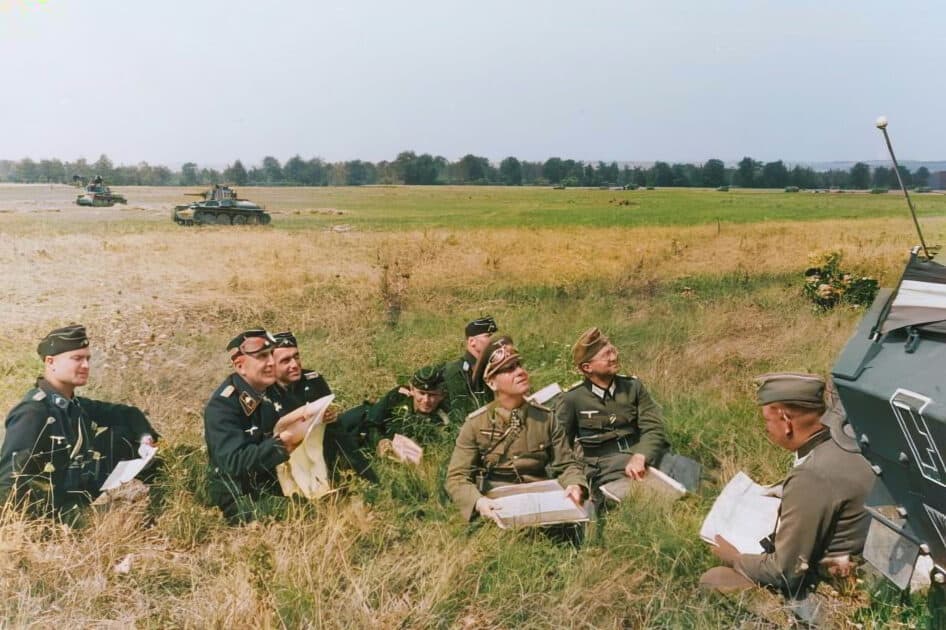
- The more urgent the situation, the shorter must be the order. Verbal orders, where the circumstances allow, must be given based on the actual terrain and not simply on the basis of map inspection. This is especially true for subordinate commanders in the front line.
- An order transmitted by technical means must be verified or authenticated. Such an order should be repeated to the sender. In the case of important orders, it is better to use two or more means of
transmission. - The time required for the arrival of an order is often underestimated. In some cases it may be necessary for the issuing commander to verify the receipt and execution of the order.
- Issuing too many orders, especially during a battle when messages may be lost, creates the serious risk of loss of independence of subordinate commanders.
- In accordance with special procedures (Chapter XVII), secret orders must be encoded, except those that relate to the immediate coordination of various arms. Orders also must be transmitted by wire when a danger
of interception exists. In special situations, written orders also should be partially or totally
encoded. - An order should contain all that a subordinate needs to know to be able to execute his mission—and nothing more. Accordingly, the order must be short, clear, specific, and complete. It must be understandable by
the recipient and conform to his situation. The commander who issues the order must always put himself in the position of the recipient. The language of orders must be simple and understandable. Clarity
that eliminates any doubt is more important than correct format. Clarity must not be sacrificed for brevity. Meaningless expressions and figures of speech that lead to partial measures should be avoided at all costs. Exaggerations make dull reading. Orders may only be valid as long they relate to the situation and
conditions. Nonetheless, it often is necessary to issue orders when the situation is obscure or uncertain. - If changes in the situation are anticipated before an order can be executed, the order should not go into detail. This is especially important in larger operations, when orders must be issued for several days in advance.
The general intent is stated and the end to be achieved must especially be emphasized. The general intent must be stated for the execution of impending operations, but the method of execution is left to the subordinate commanders. Otherwise, the order becomes a directive. - In order to maintain secrecy, careful consideration must be given to how far and to whom the intent of the operation is revealed. In special operations, commanders occasionally are informed by special written instructions or in person by liaison officers sent from headquarters. In larger operations there should be no hesitation in giving a thorough analysis of the intent and detailed mission orders for the battle to ensure coordination in the common objective. When the battle starts, there should be no doubt in any commander regarding the intent of the senior commander. As far as the situation permits, the commander will explain his intent verbally to his subordinate commanders. He may not, however, become dependent on his subordinates. Decisions and orders are his responsibilities alone.
- Written orders that direct the assignment of different elements to the common objective should be divided into numbered paragraphs. The important information must be put first. Matters relating to each unit or element are placed in separate paragraphs under separate numbers.
- Operations orders coordinate the actions of combat units and give the necessary instructions for the combat and service trains. Orders are designated according to the name of the issuing headquarters (e.g., army,
corps, divisional, regimental order, etc.), or if more practical, according to the task organization (e.g., advance guard, outpost order) or according to individual arms (e.g., artillery order). - The following sequence should be used for operations orders (Operationsbefehle):
Information about the enemy and about adjacent units, as far as they are important to the recipient.
The intent of the commander, so far this information is necessary for the accomplishment of the mission.
Missions for the elements of the entire command.
Orders for the light motorized columns, the field trains, the baggage trains, the combat echelon, and the other rear units, as far as this is important for those units.
The position of the command post and the procedures for communications to and from the commander.
The exact elements to be included in the operations order depend on the particular situation. Information about the enemy also should include the commander’s estimate of the enemy’s intent. Estimates and assumptions must be indicated as such. The reasoning behind specifically ordered measures will only be included in the order in exceptional situations. Detailed instructions covering all possible situations, particularly those that are matters of standard training, do not belong in an order. - A warning order (Vorbefehl) is often issued prior to the main order.
The warning order should contain the most current information on the situation. This allows subordinate commanders to make the most immediate preparations. A warning order also can be used to place units in rest status earlier, or to extend their rest period. Warning orders are especially effective when units can be informed verbally by telephone or radio. - Often, the urgency of a situation requires the issue of simple extracts of orders. These fragmentary orders (Einzelbefehl) are extracts of the main order and must contain everything that the recipient needs to
know for the execution of the mission. Through the use of fragmentary orders, not all units will necessarily be
informed of the overall picture. In larger operations the complete operations order usually follows. In other situations individual commanders should be informed of the most important elements of the overall situation
as soon as possible. - The unit task organization is detailed separately from the main body of the operations order, and listed by branch in the following sequence:
Infantry, cavalry, horse and motorized reconnaissance battalions, artillery, armor, chemical troops, engineers, signal, horsed or motorized transport, medical and veterinary troops, other troops (air forces and air
defense units).
If the march sequence is already fixed in the order, the units will be so designated in the task organization. The corresponding unit organization (main body, advance guard, rear guard, etc.) will contain the notation,
“according to march sequence.” Likewise in a retrograde movement, units must be specified in march sequence. - The ending of an order should indicate the issuing authority and the manner of distribution. The time the order is completed or the hour of transmission must be indicated.
Commanders and their key staff should only be called together for an orders brief when required by the situation. - In most cases, the higher headquarters operations order with its annexes is not passed in complete form to subordinate units. Subordinate commanders issue their own orders based on the order of the higher headquarters, including all necessary information and instructions. The divisional operations order generally forms the basis for orders to the subordinate units.
- Orders for a withdrawal or retreat should be communicated in a secure manner to the next lower commanders only.
- Operations orders must avoid all forms of stereotyping. Task organizing units might be necessary in some situations, but in combat the commander should deploy his units based on the standard organization tables whenever possible. The situation dictates whether an operations order is issued as a complete order or as a fragmentary order. The form of the order must ensure the coordination of all elements.
- Special instructions (besondere Anordnungen) to supplement the operations order contain information not necessarily required by the entire command. They detail the missions and tasks of the individual arms, the
resupply of ammunition, motor transport maintenance and supply, medical and veterinary service, food supply, the supply of weapons material and equipment, and sometimes the actions of the field supply and baggage trains. In order to ensure speed and brevity in the orders process, it may be necessary to include such information in the main operations order. In all other situations, all necessary orders issued by the commander to the supply services will be issued as special orders.
Special instructions go only to the element concerned. If these elements do not receive the basic operations order, then the information relevant to them must be contained in the special order.* - Corps and divisional orders of the day (Tagesbefehle) concern internal functions, personnel actions, promotions, decorations, etc.
- Staff orders (Stabsbefehle) regulate the internal functions of the staffs.
